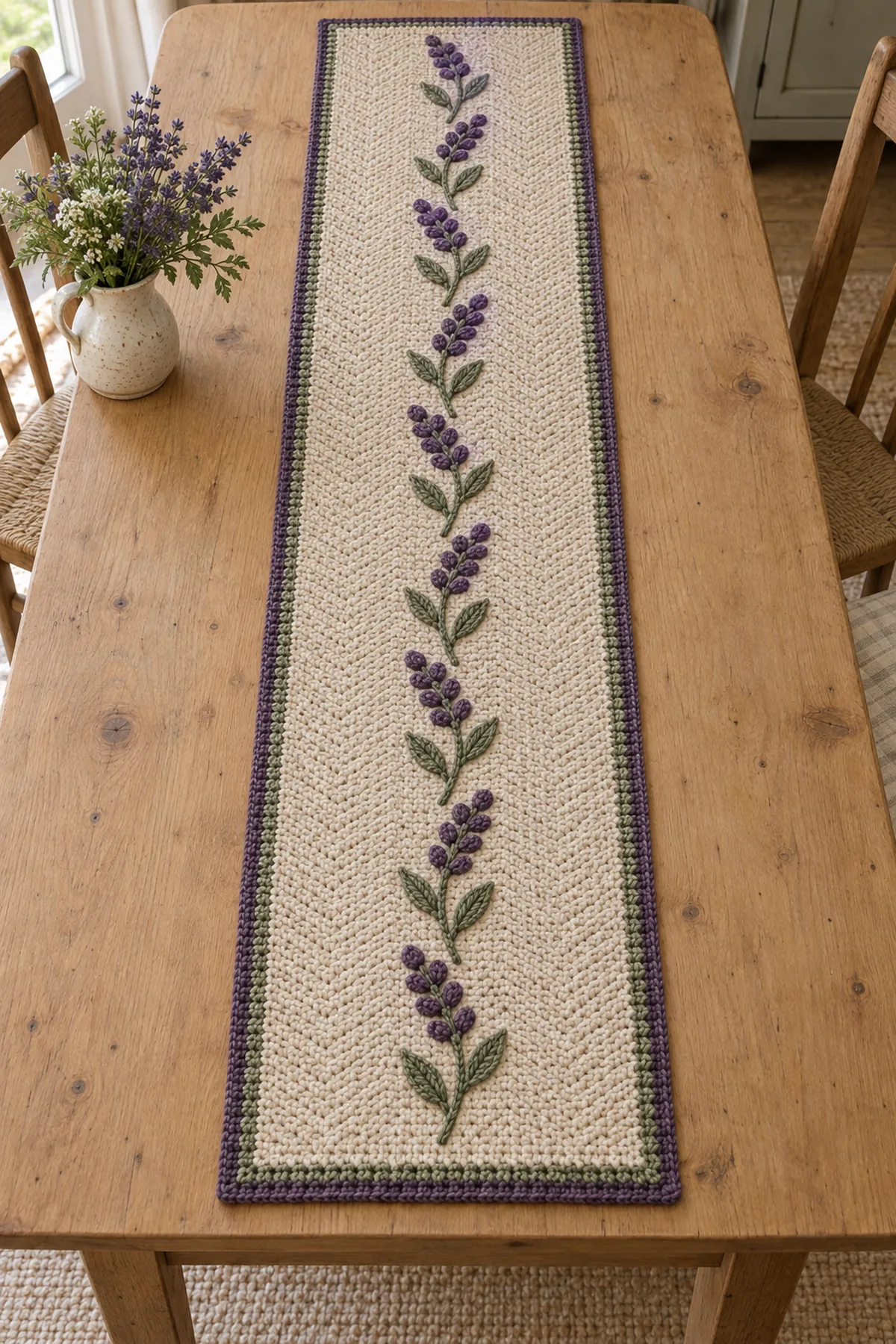
This crochet lavender sprig table runner begins with a tailored oatmeal herringbone fabric. Nine slim green stems rise in alternating directions across the long base, each carrying seven purple bobble buds and two narrow sage leaves.
Work a 58-stitch herringbone-half-double-crochet rectangle for 140 rows, add a narrow sage-and-plum border, and surface-crochet nine measured stems. Make sixty-three bobble buds directly along the stems and finish each sprig with two small leaves.
Why You’ll Love This Project
The solid base is practical beneath tableware, while the slim vertical motifs provide strong visual rhythm. Bobbles form recognizable lavender buds without separate flower sewing, and the restrained palette suits spring through late summer.
Materials
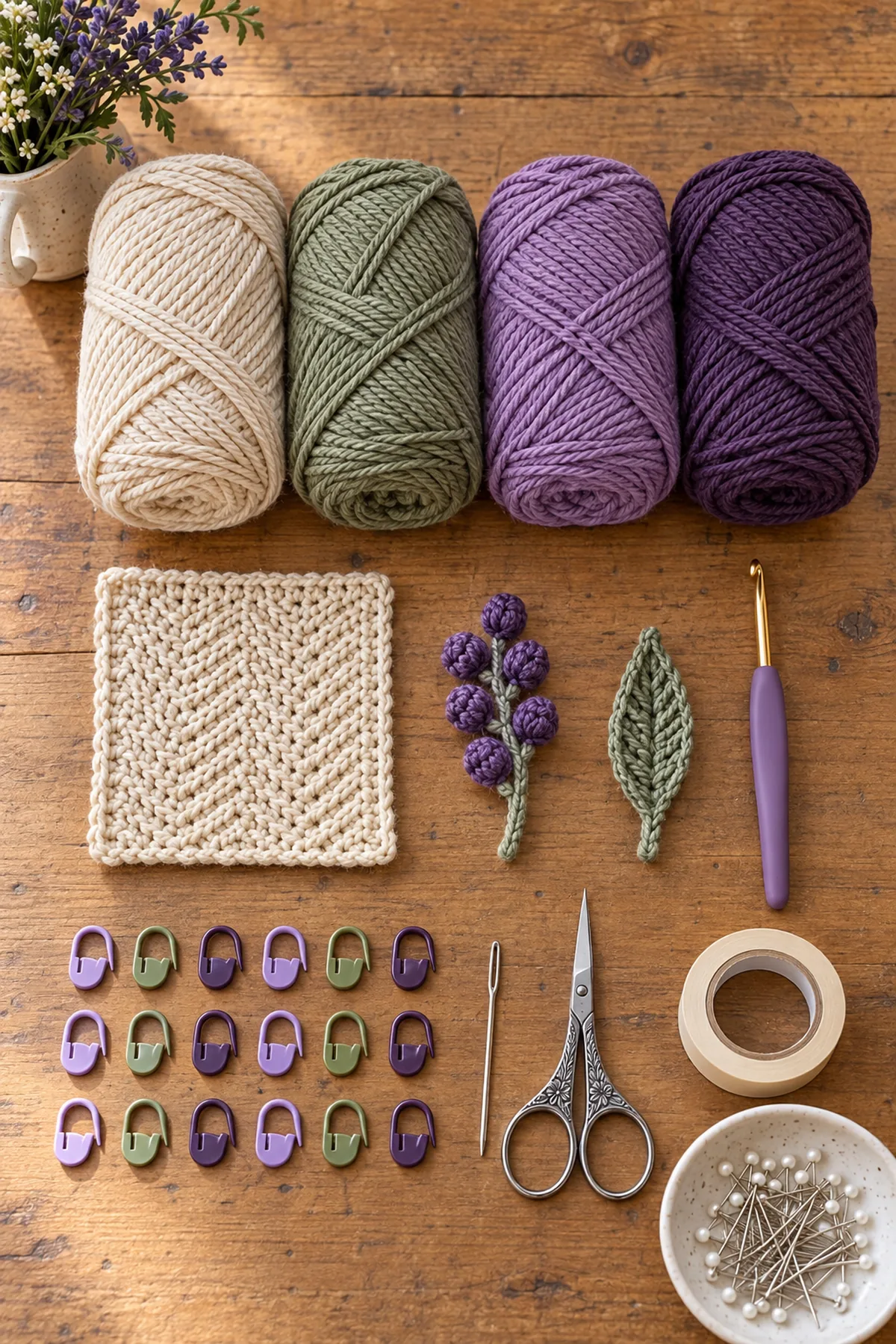
- Approximately 760 yards oatmeal worsted-weight cotton yarn
- Approximately 150 yards sage-green cotton yarn
- Approximately 110 yards lavender-purple cotton yarn
- Approximately 55 yards deep-plum cotton yarn
- 4.5 mm crochet hook
- Eighteen locking stitch markers
- Yarn needle
- Scissors
- Tape measure
- Blocking mats and rustproof pins
Gauge, Measurements, and Planning
Thirty herringbone half-double-crochet stitches should measure 8 inches and 24 rows should measure 8 inches. The 58 stitches and 140 rows plus the border finish close to 15 by 50 inches.
Make and wash a gauge swatch before beginning. Measure only after the swatch is completely dry. If the stitch width differs, change hook size rather than pulling the working yarn tighter. Keep a written count at the end of every section so the finished edges remain balanced and the assembly points line up.
Abbreviations and Special Stitches
- ch: chain
- dc: double crochet
- hdc: half double crochet
- sc: single crochet
- sl st: slip stitch
- st(s): stitch(es)
- BLO: back loop only
- yo: yarn over
Special stitch guidance: Herringbone hdc: yarn over, insert the hook, pull up a loop and pull it through the first loop on the hook, then yarn over and pull through both remaining loops. Four-dc bobble: work four partial double crochets in one anchor, then yarn over and close all loops. Surface slip stitch: draw a loop through the fabric and the loop on the hook.
Before You Begin
- Beginning chain 1 does not count as a stitch.
- Maintain 58 stitches for all 140 rows.
- Mark all nine stem lines on the blocked base.
- Each sprig receives exactly seven buds and two leaves.
Instructions
Crochet the Oatmeal Herringbone Base
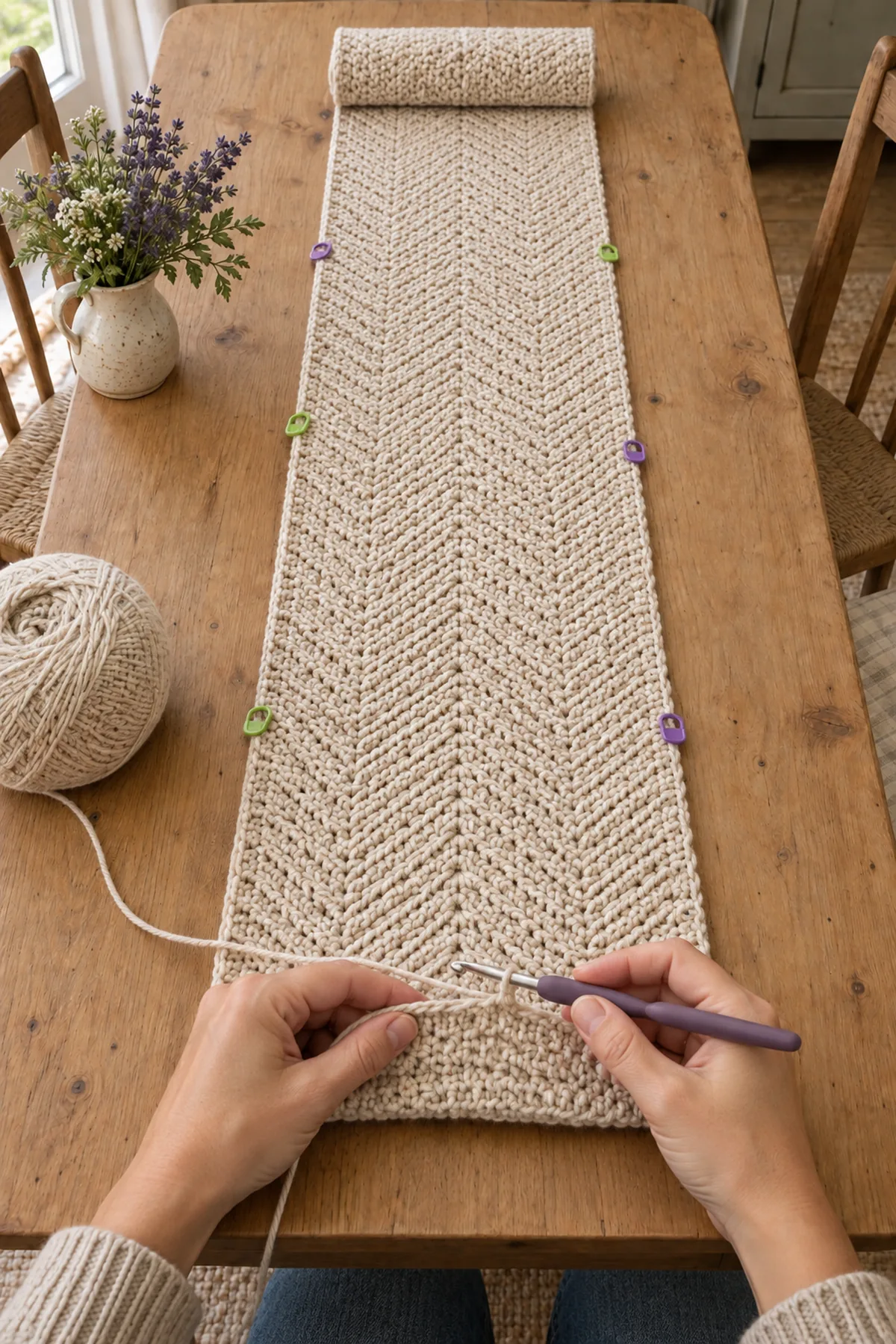
Use oatmeal and mark both edge stitches.
- Foundation Row: Ch 60. Hdc in the third chain from the hook and across. Turn. (58 sts)
- Row 1: Ch 1, herringbone hdc in every stitch across. Turn. (58 sts)
- Rows 2–140: Repeat Row 1, maintaining 58 stitches.
- Fasten off and block the rectangle to approximately 14 by 49 inches.
Add the Tailored Striped Border
Use sage first and deep plum for the final accent.
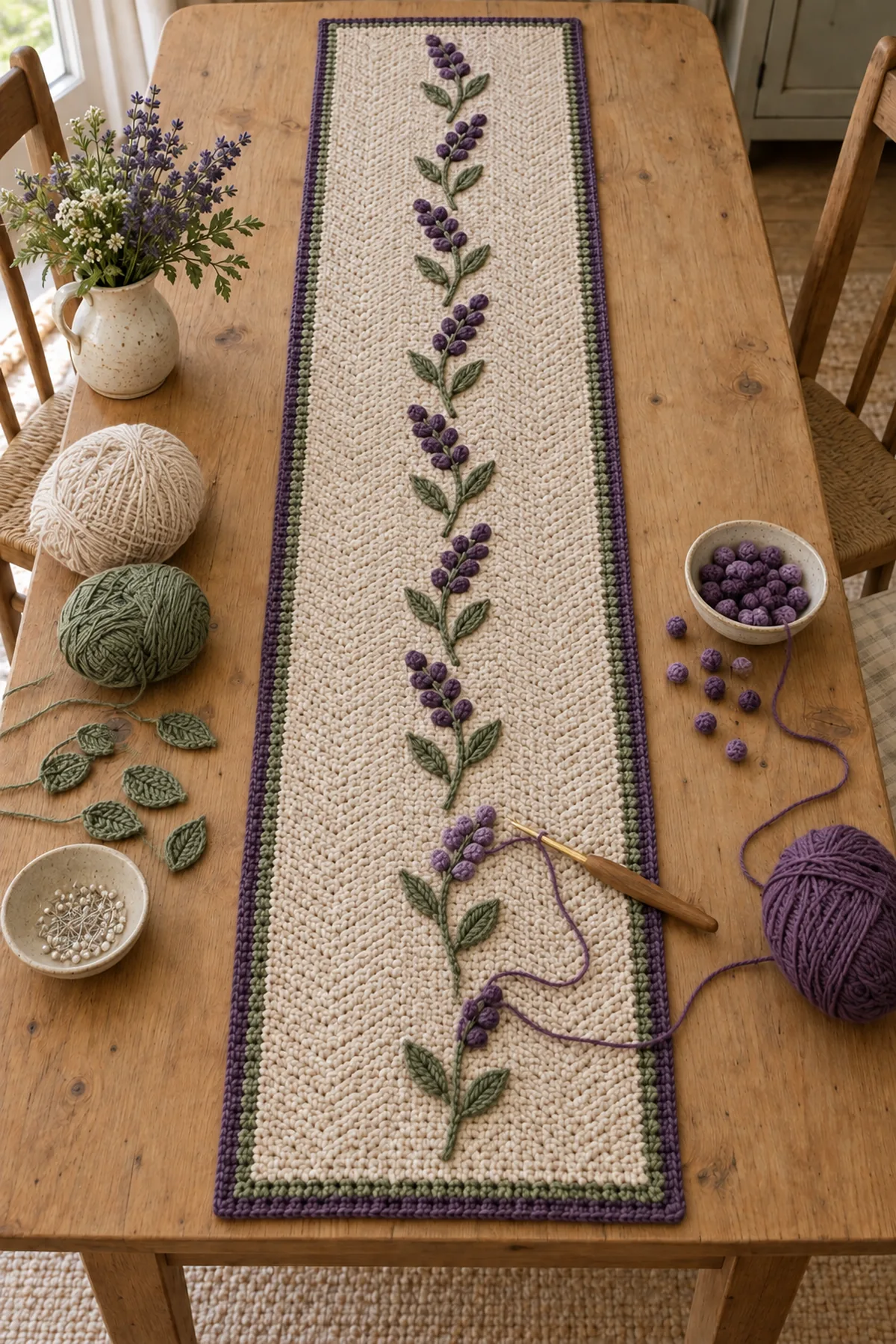
- Border Round 1: Join sage and sc evenly around, placing 3 sc in each corner.
- Border Round 2: Continue in sage and work BLO sc in every stitch with 3 BLO sc at corners.
- Border Round 3: Change to deep plum and work slip stitch loosely in every stitch.
- Join invisibly and block the bordered base flat.
Surface-Crochet Nine Lavender Stems
Alternate stem direction for a gentle botanical rhythm.
- Mark nine 10-inch stem lines, spacing their bases approximately 5 inches apart.
- Angle stems 1, 3, 5, 7, and 9 toward the right and the remaining stems toward the left.
- With sage, surface-slip-stitch along every marked line.
- Add two short side branches near the upper half of each stem.
Add Sixty-Three Buds and Eighteen Leaves
Use lavender and plum buds in a seven-bud sequence.
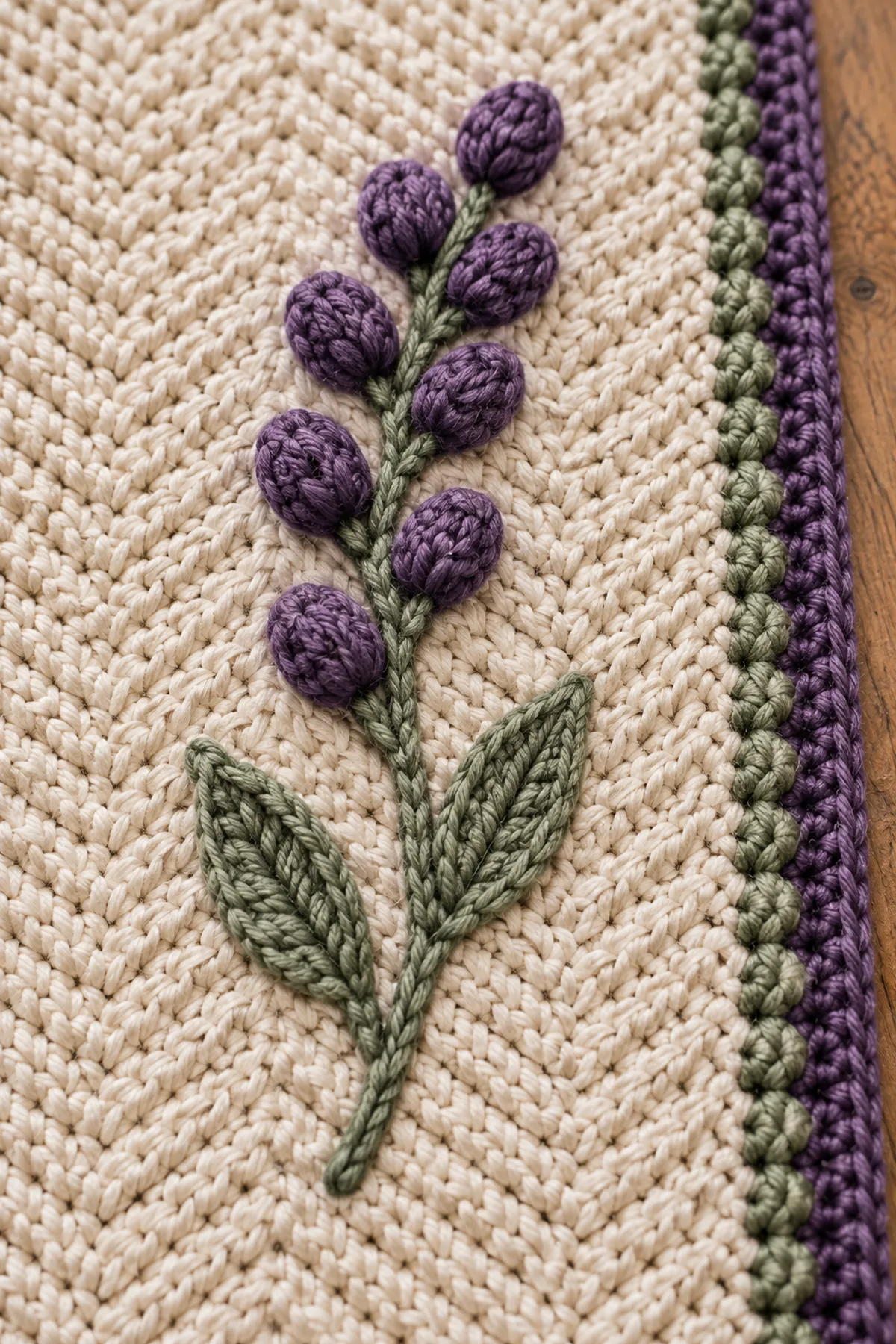
- On each stem, work four lavender bobbles and three plum bobbles at marked anchors from tip downward. (7 buds per stem)
- Repeat across all nine stems for sixty-three buds total.
- For each leaf, ch 8 and mirror sc, hdc, 3 dc, hdc, sc along both sides. Make eighteen in sage.
- Sew two leaves near the base of each sprig and steam lightly from the wrong side.
Assembly and Shaping
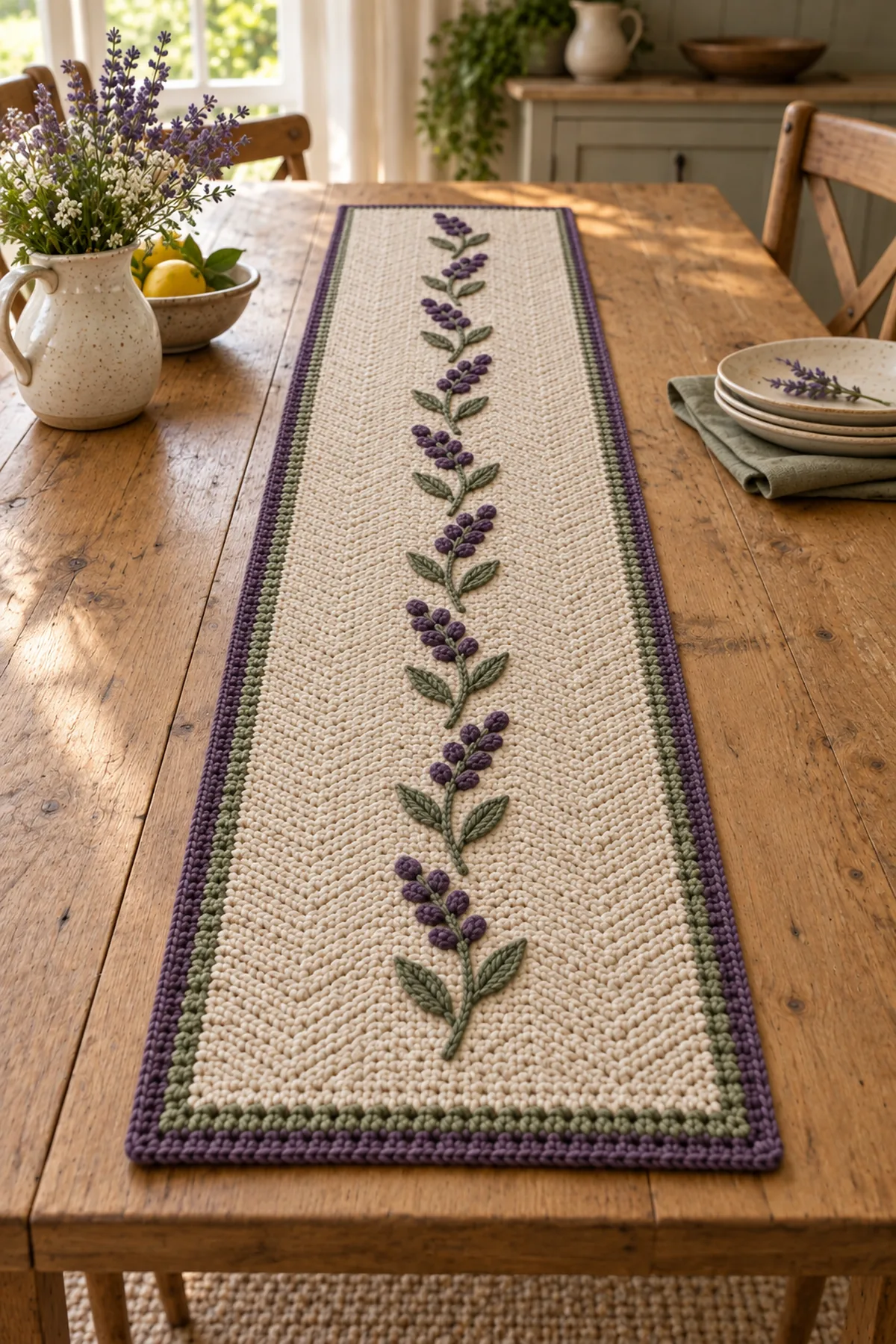
Center the fifth stem on the runner and measure outward in both directions. Alternate the lean of neighboring sprigs, keep the lowest leaves 1 inch above the border, and verify nine complete seven-bud sequences.
Lay every component on a flat surface before joining. Match the marked centers first, then divide each remaining edge into equal sections. Work through both layers with consistent tension and pause after each section to check that the fabric lies flat. This measured approach prevents twisting and keeps decorative details facing the intended direction.
Finishing
- Weave oatmeal tails through herringbone rows.
- Secure surface stems at top and base.
- Tie off every bobble anchor on the wrong side without puckering.
- Mist-block to 15 by 50 inches and lift all buds.
For a polished result, weave each tail through several same-color stitches, reverse direction once, and trim only after the fabric has been gently stretched. Block to the listed dimensions without flattening textured stitches. Inspect joins, borders, straps, and decorative pieces before the project is used or gifted.
Helpful Tips
- Use a ruler to mark even stem spacing.
- Work all stems before switching to purple yarn.
- Count buds in groups of seven.
- Keep the plum slip-stitch edge loose enough to lie flat.
Good lighting and a contrasting stitch marker make counting much easier. If a section looks uneven, compare the current count with the previous checkpoint before continuing. Fixing one missed stitch early is faster than compensating later, and it preserves the measurements used by the assembly instructions.
Frequently Asked Questions
Can I use one purple shade?
Yes. One lavender shade keeps the botanical silhouette while preserving the seven-bud count.
Why is my base slanting?
Turn consistently and mark both edge stitches so all 58 stitches are maintained.
Can I make shorter sprigs?
Yes. Shorten every marked stem equally and keep two leaves and seven closer-spaced buds.
Conclusion
The finished lavender runner combines a structured oatmeal foundation with nine measured sprigs and sixty-three raised buds. Sage framing and a fine plum accent give the botanical design a polished, tailored finish.
Printable Crochet Pattern Card
Project: Crochet Lavender Sprig Table Runner
Skill level: Intermediate Hook: 4.5 mm Yarn: Worsted
Finished size: Approximately 15 inches wide by 50 inches long
Card Materials
- Approximately 760 yards oatmeal worsted-weight cotton yarn
- Approximately 150 yards sage-green cotton yarn
- Approximately 110 yards lavender-purple cotton yarn
- Approximately 55 yards deep-plum cotton yarn
- 4.5 mm crochet hook
- Eighteen locking stitch markers
- Yarn needle
- Scissors
- Tape measure
- Blocking mats and rustproof pins
Card Instructions
- Crochet the Oatmeal Herringbone Base: Work a 58-stitch oatmeal herringbone rectangle for 140 rows.
- Add the Tailored Striped Border: Frame the base with two sage rounds and one narrow deep-plum accent.
- Surface-Crochet Nine Lavender Stems: Work nine measured sage stems with alternating lean and two branches each.
- Add Sixty-Three Buds and Eighteen Leaves: Add seven bobble buds and two leaves to each of nine lavender sprigs.
Finish: Check every count, weave in all ends, block to measurement, and inspect each join.