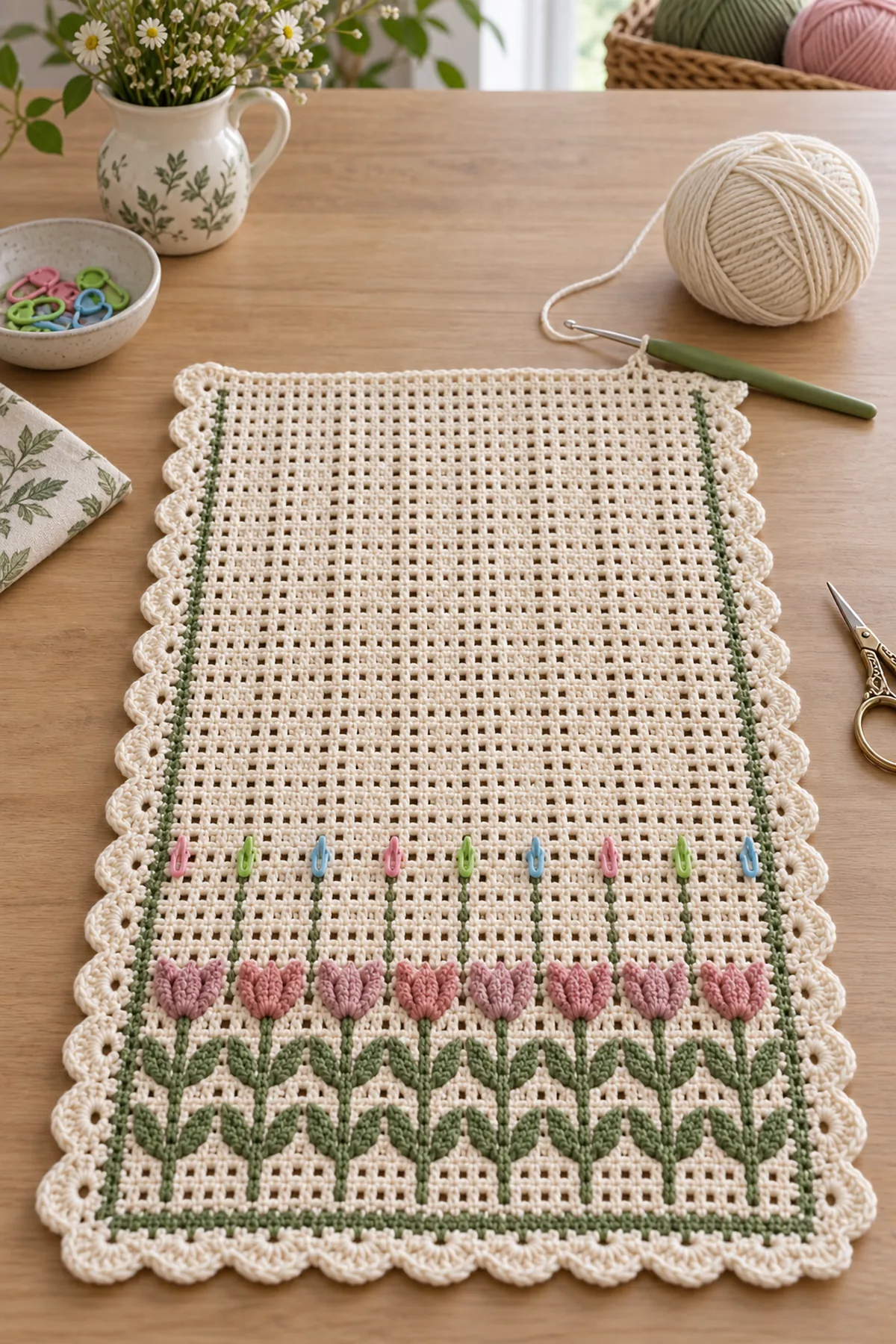
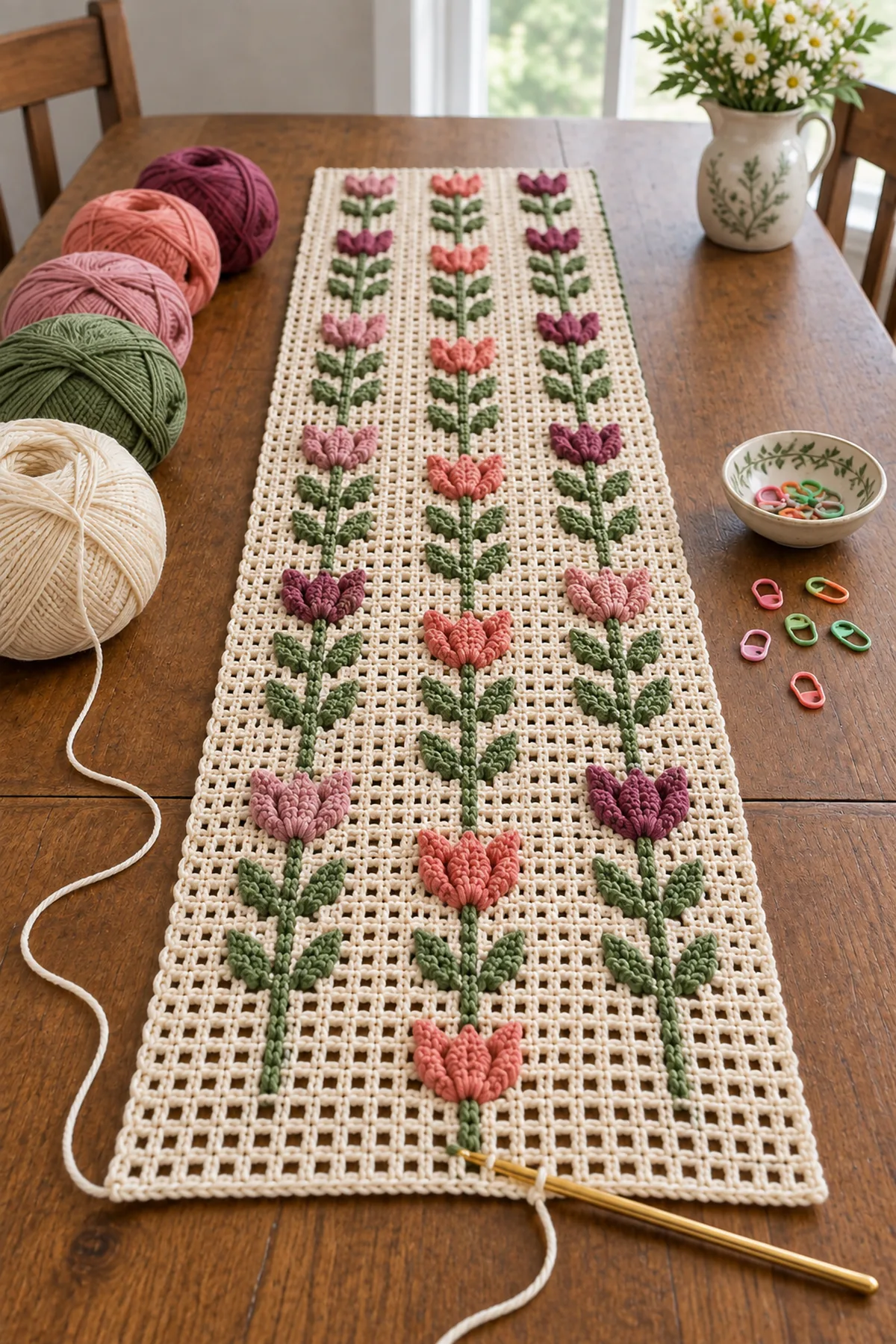
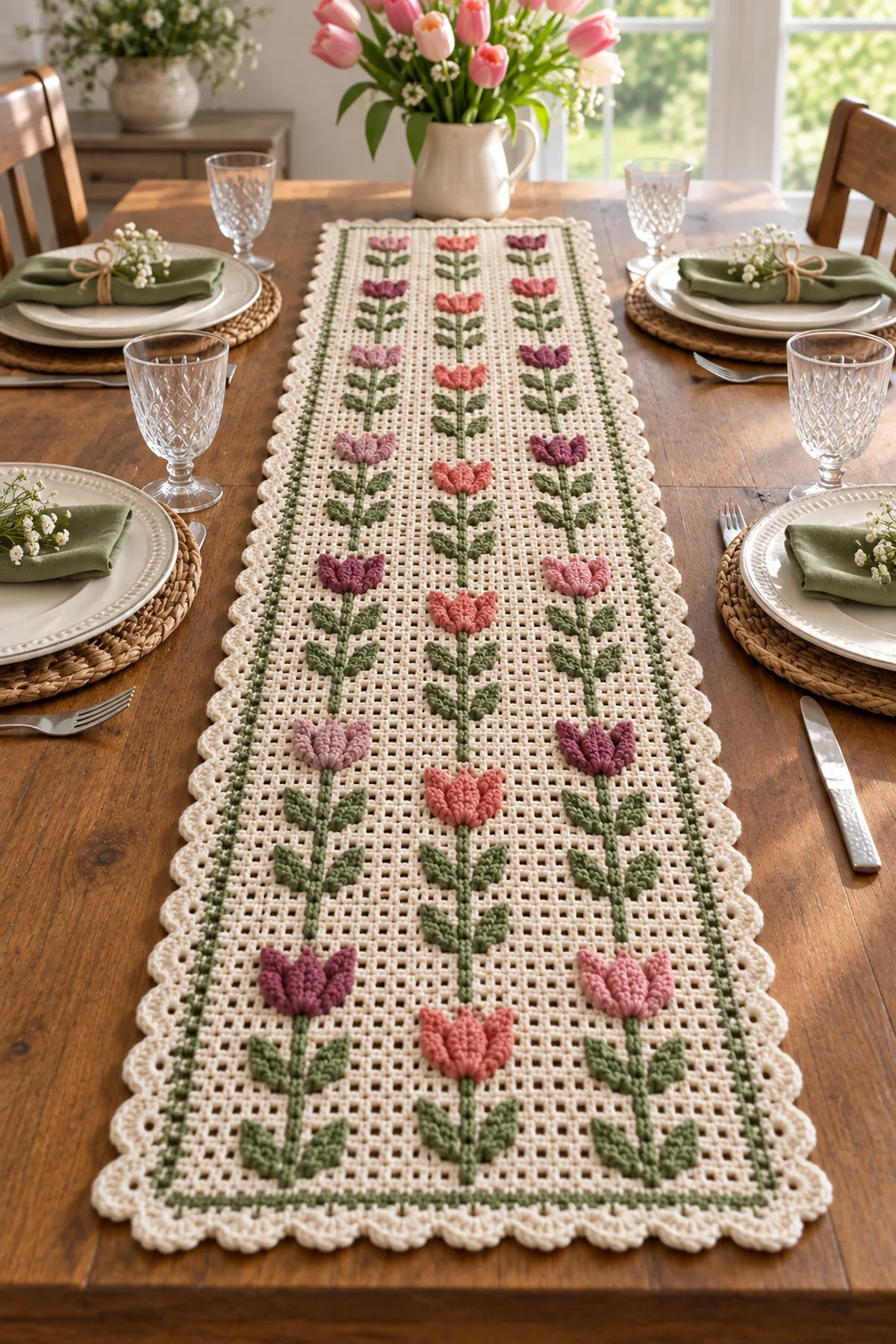
This crochet tulip garden table runner forms its flowers directly in the fabric. A counted eight-row repeat alternates cream filet lattice, sage stem rows, and raised tulip popcorns in pink, coral, and plum, so there are no separate flower appliqués to sew.
Begin with 71 counted positions and work fourteen complete eight-row tulip repeats for a long lace rectangle. Change color only on the designated stem and flower rows, then stabilize the openwork with sage stripes and finish with cream scallops.
Why You’ll Love This Project
The tulips are stitch-built within the repeating lace rather than joined motifs or surface decoration. Three rotating flower colors create a garden rhythm while the fixed 71-position count keeps the runner straight.
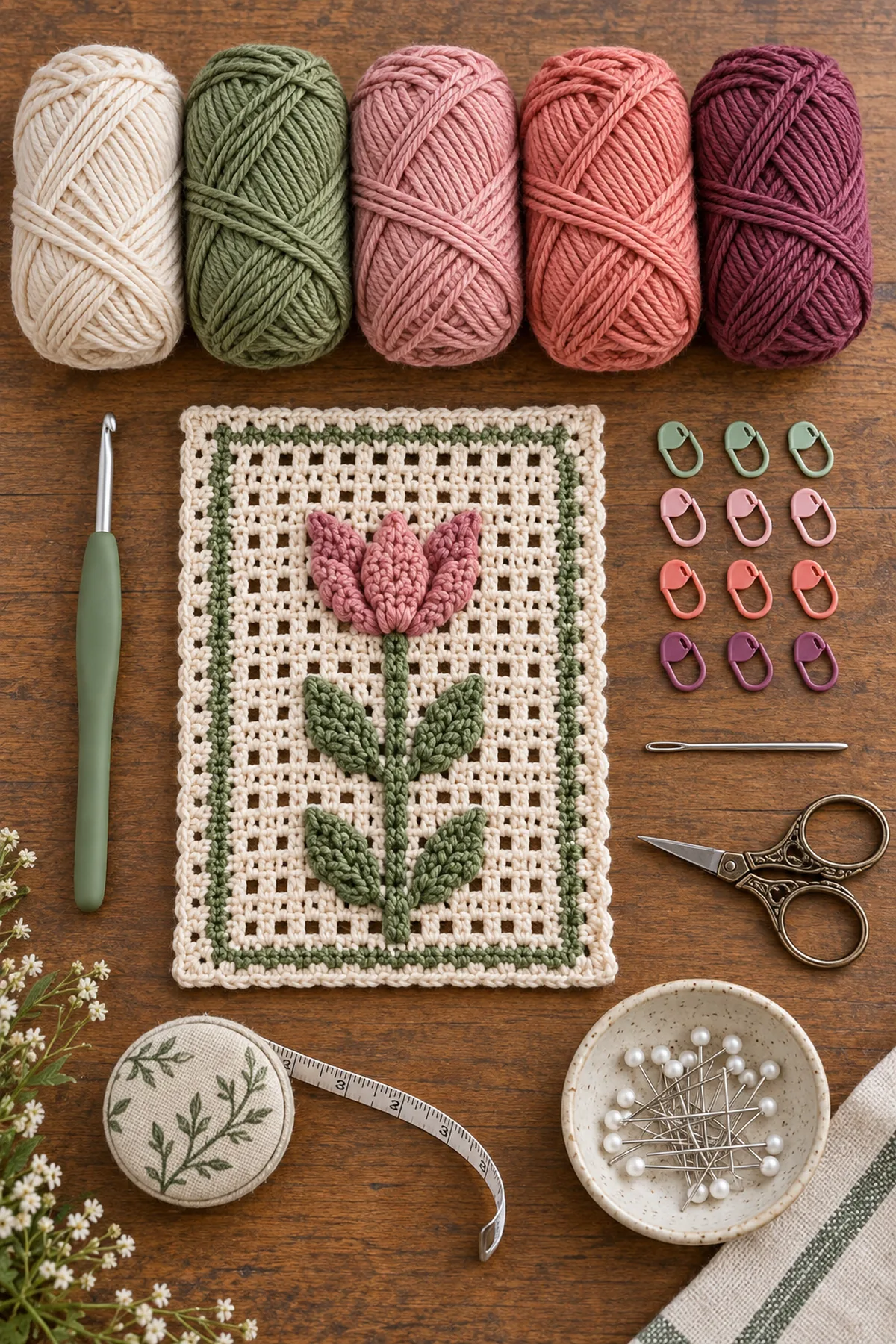
Materials
- Approximately 620 yards cream worsted-weight cotton yarn
- Approximately 150 yards sage-green cotton yarn
- Approximately 65 yards dusty-pink cotton yarn
- Approximately 65 yards coral cotton yarn
- Approximately 65 yards plum cotton yarn
- 4 mm crochet hook
- Fourteen locking stitch markers
- Yarn needle
- Scissors
- Tape measure
- Blocking mats and rustproof pins
Gauge, Measurements, and Planning
Thirty-six counted lattice positions should measure 8 inches and 18 rows should measure 8 inches after blocking. Fourteen eight-row repeats plus the border finish close to 50 inches long.
Make and wash a gauge swatch before beginning. Measure only after the swatch is completely dry. If the stitch width differs, change hook size rather than pulling the working yarn tighter. Keep a written count at the end of every section so the finished edges remain balanced and the assembly points line up.
Abbreviations and Special Stitches
- ch: chain
- dc: double crochet
- hdc: half double crochet
- sc: single crochet
- sl st: slip stitch
- st(s): stitch(es)
- BLO: back loop only
- yo: yarn over
Special stitch guidance: Five-dc popcorn: work 5 dc in the same stitch, remove the hook, insert it through the first dc, return the loop to the hook, and pull through. Filet lattice: double crochet in the next stitch, chain 1, and skip the next stitch. Split tulip cluster: popcorn in the marked center, chain 2, and popcorn in the same center.
Before You Begin
- Beginning chain 3 counts as the first double crochet on lace rows.
- Maintain 71 counted positions across all 112 pattern rows.
- Carry cream only across one color row; cut yarn between repeats.
- Rotate dusty pink, coral, and plum for successive flower rows.
Instructions
Establish the Cream Filet Lattice
Mark the first, center, and last counted positions.
- Foundation Row: Ch 74. Dc in the fourth chain from the hook and across. Turn. (71 sts)
- Repeat Row 1: With cream, ch 3, repeat [ch 1, skip 1 stitch, dc in next stitch] across, ending with dc in the last stitch. Turn. (71 positions)
- Row 2: Dc in each dc and each chain-1 space across. Turn. (71 sts)
- Keep the center position marked for the tulip layout.
Work One Eight-Row Tulip Repeat
Use sage for stems and one flower color for the raised buds.
- Row 3: With sage, dc in every stitch, working front-post dc at nine evenly marked stem positions. Turn. (71 sts)
- Row 4: With cream, repeat the filet-lattice row across. Turn. (71 positions)
- Row 5: With the flower color, work cream-aligned dc across and make one five-dc popcorn at each of the nine stem positions. (71 positions)
- Row 6: With cream, work dc across, making a split tulip cluster around every marked popcorn.
- Rows 7–8: Repeat the cream filet row and solid dc row. (71 positions each)
Complete Fourteen Garden Repeats
Rotate flower colors without changing the stitch count.
- Repeat Rows 1–8 thirteen more times for fourteen repeats total and 112 pattern rows.
- Use dusty pink for repeats 1, 4, 7, 10, and 13; coral for 2, 5, 8, 11, and 14; plum for 3, 6, 9, and 12.
- Count 71 positions at the end of every row and move all nine stem markers upward.
- Fasten off after the final solid cream row and block the lace rectangle to 15 by 49 inches.
Add the Striped Scallop Border
Stabilize the lace before making the decorative edge.
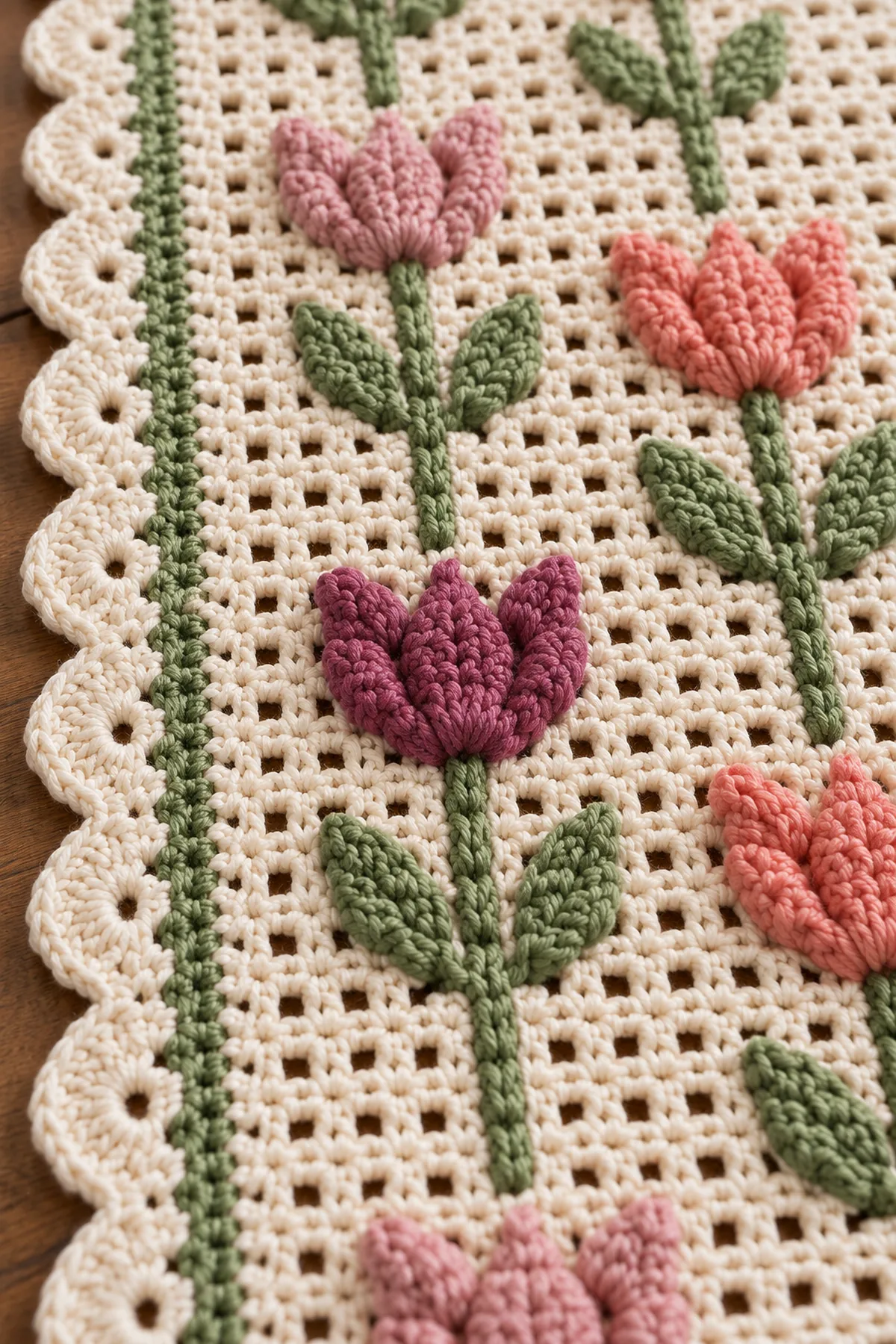
- Border Round 1: Join sage and sc evenly around, placing 3 sc in each corner.
- Border Round 2: Continue in sage and work BLO sc in every stitch with 3 BLO sc in corners.
- Border Round 3: Change to cream and repeat [skip 1 stitch, 5 dc in next stitch, skip 1 stitch, slip stitch in next stitch] around.
- Join invisibly and block to 16 by 50 inches.
Assembly and Shaping
No motif sewing is required. Keep the nine stem markers vertically aligned through every repeat, complete each color change on the final yarn-over, and block the integrated flower fabric before bordering.
Lay every component on a flat surface before joining. Match the marked centers first, then divide each remaining edge into equal sections. Work through both layers with consistent tension and pause after each section to check that the fabric lies flat. This measured approach prevents twisting and keeps decorative details facing the intended direction.
Finishing
- Weave cream tails along solid rows.
- Secure color-row tails behind matching popcorn stitches.
- Mist-block the runner to 16 by 50 inches.
- Lift each raised tulip cluster after drying.
For a polished result, weave each tail through several same-color stitches, reverse direction once, and trim only after the fabric has been gently stretched. Block to the listed dimensions without flattening textured stitches. Inspect joins, borders, straps, and decorative pieces before the project is used or gifted.
Helpful Tips
- Use nine locking markers for the stem columns.
- Write down the flower color after each repeat.
- Check 71 positions before every color change.
- Keep popcorn closures loose enough to remain dimensional.
Good lighting and a contrasting stitch marker make counting much easier. If a section looks uneven, compare the current count with the previous checkpoint before continuing. Fixing one missed stitch early is faster than compensating later, and it preserves the measurements used by the assembly instructions.
Frequently Asked Questions
Can I use one tulip color?
Yes. One flower color preserves the stitch-built design and simplifies yarn changes.
Why is my lace narrowing?
An edge double crochet or chain space has been missed; mark both edges and count 71 positions every row.
Can I shorten the runner?
Remove complete eight-row repeats; each repeat changes the blocked length by about 3.25 inches.
Conclusion
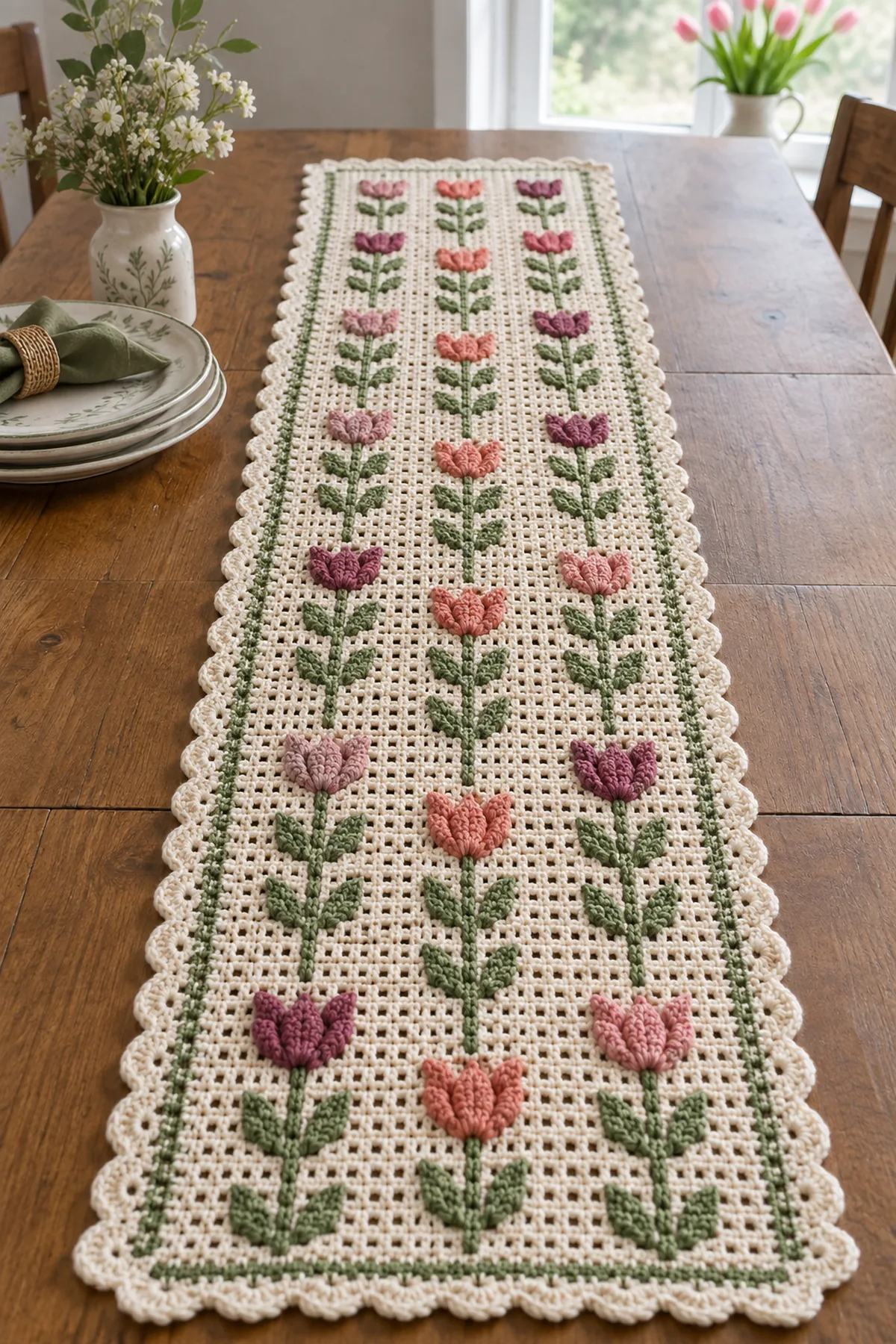
The completed tulip garden runner grows as one integrated lace fabric. Raised flower stitches, aligned sage stems, and three rotating tulip colors distinguish it clearly from joined daisy motifs and surface-decorated botanical runners.
Printable Crochet Pattern Card
Project: Crochet Tulip Garden Table Runner
Skill level: Intermediate Hook: 4 mm Yarn: Worsted
Finished size: Approximately 16 inches wide by 50 inches long
Card Materials
- Approximately 620 yards cream worsted-weight cotton yarn
- Approximately 150 yards sage-green cotton yarn
- Approximately 65 yards dusty-pink cotton yarn
- Approximately 65 yards coral cotton yarn
- Approximately 65 yards plum cotton yarn
- 4 mm crochet hook
- Fourteen locking stitch markers
- Yarn needle
- Scissors
- Tape measure
- Blocking mats and rustproof pins
Card Instructions
- Establish the Cream Filet Lattice: Establish a 71-position cream filet lattice with marked edges and center.
- Work One Eight-Row Tulip Repeat: Build nine sage stems and nine raised tulip buds within one counted eight-row lace repeat.
- Complete Fourteen Garden Repeats: Work fourteen eight-row repeats, rotating three tulip colors and preserving 71 positions.
- Add the Striped Scallop Border: Frame the integrated tulip lace with two sage rounds and cream scallops.
Finish: Check every count, weave in all ends, block to measurement, and inspect each join.