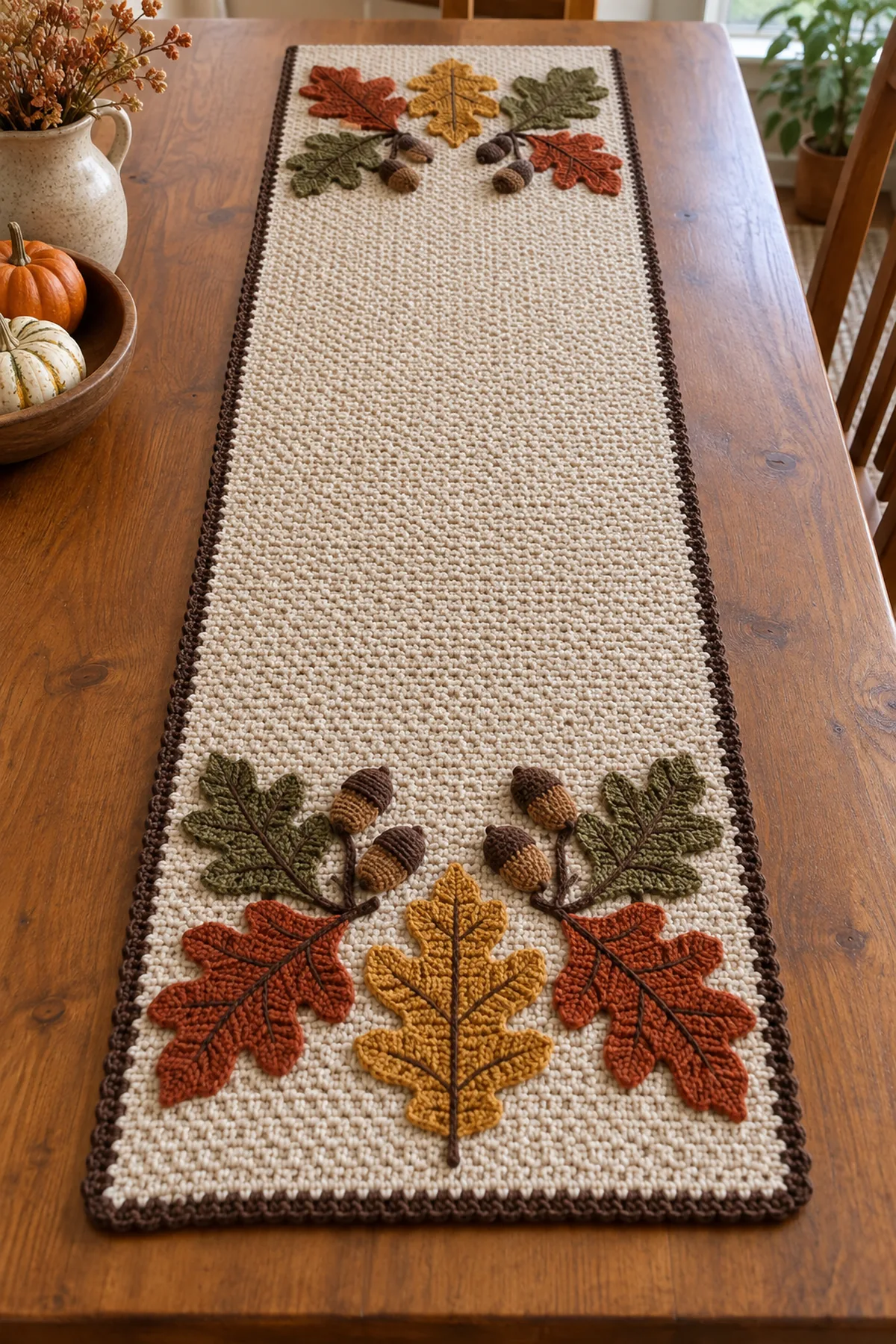
This crochet fall oak leaf table runner celebrates the lobed silhouette and warm color shifts of real autumn oak leaves. Unlike the earlier maple-leaf runner, its base is worked lengthwise in linen stitch, while deeply notched leaves and small acorns form two balanced clusters rather than a single diagonal trail.
Begin with a 181-stitch lengthwise foundation and work 45 linen-stitch rows for a low-profile woven base. Add a reverse-single-crochet border, crochet nine shaped oak leaves from center spines, make six acorns, and stitch the motifs into mirrored arrangements near the runner ends.
Why You’ll Love This Project
Lengthwise rows create elegant continuous color and fewer short-edge joins. The oak leaves are portable motifs, their free lobed edges add realistic dimension, and the mirrored layout leaves the center clear for a vase or serving bowl.
Materials
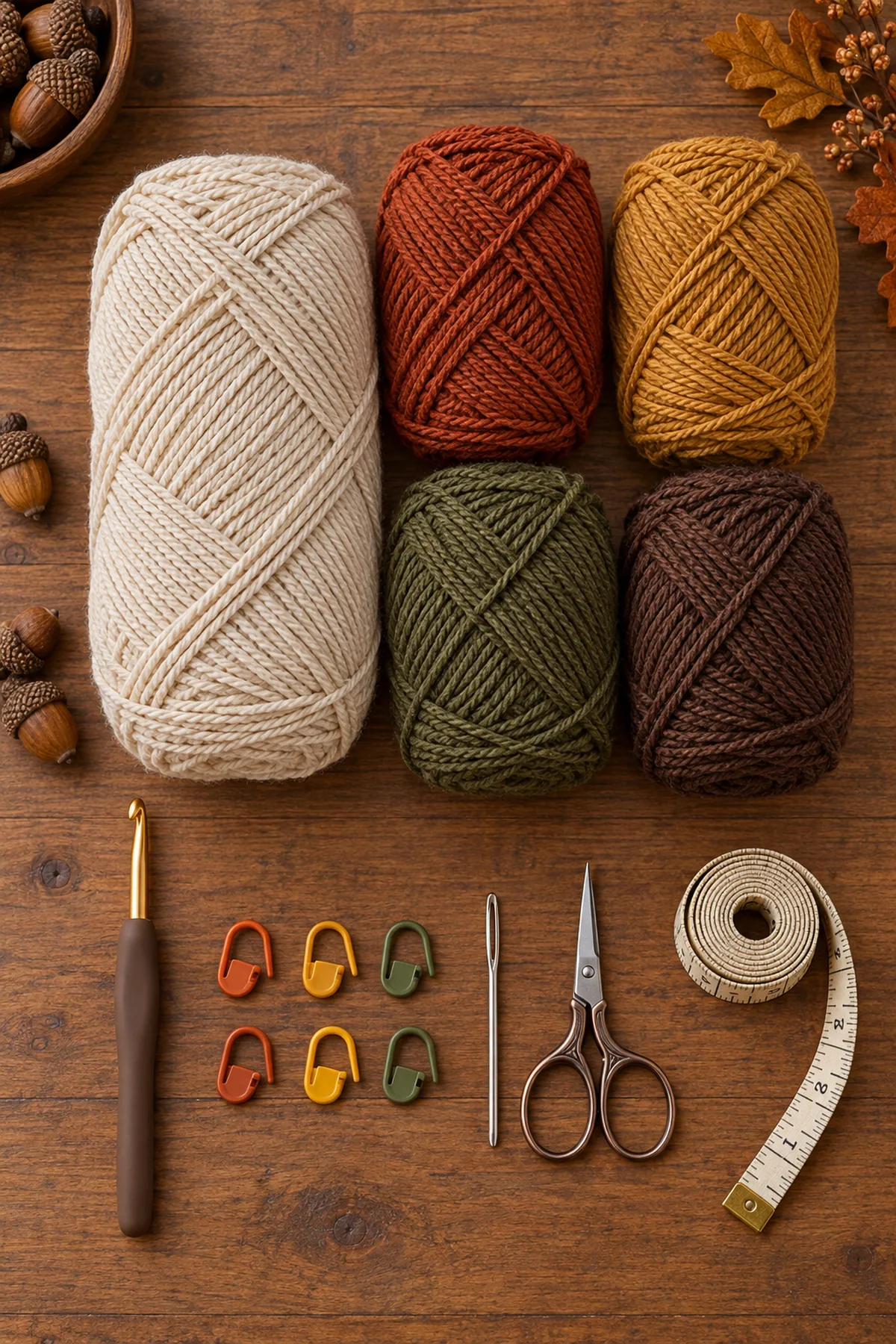
- Approximately 720 yards oatmeal worsted-weight cotton yarn
- Approximately 110 yards rust cotton yarn
- Approximately 90 yards golden ochre cotton yarn
- Approximately 75 yards olive cotton yarn
- Approximately 45 yards dark brown cotton yarn
- 4.5 mm crochet hook
- Twelve locking stitch markers
- Yarn needle
- Scissors
- Tape measure
Gauge, Measurements, and Planning
A 32-position linen-stitch swatch should measure 8 inches wide and 28 rows should measure 8 inches tall. The 181-position foundation controls the runner length; the 45 rows and border control its finished 13-inch width.
Make and wash a gauge swatch before beginning. Measure only after the swatch is completely dry. If the stitch width differs, change hook size rather than pulling the working yarn tighter. Keep a written count at the end of every section so the finished edges remain balanced and the assembly points line up.
Abbreviations and Special Stitches
- ch: chain
- dc: double crochet
- hdc: half double crochet
- sc: single crochet
- sl st: slip stitch
- st(s): stitch(es)
- BLO: back loop only
Special stitch guidance: Linen stitch: sc in the next chain-1 space, ch 1, and skip the next sc. Reverse sc: work single crochet from left to right around the border. Oak lobe: sc, hdc, dc, ch 2, sl st in the second chain, dc, hdc, sc in one marked side space.
Before You Begin
- The base is worked along its 48-inch length, so keep the foundation chain loose.
- Every linen-stitch row has 181 counted positions, including stitches and chain spaces.
- Steam-block oak leaves before arranging them, but leave the pointed lobes free when sewing.
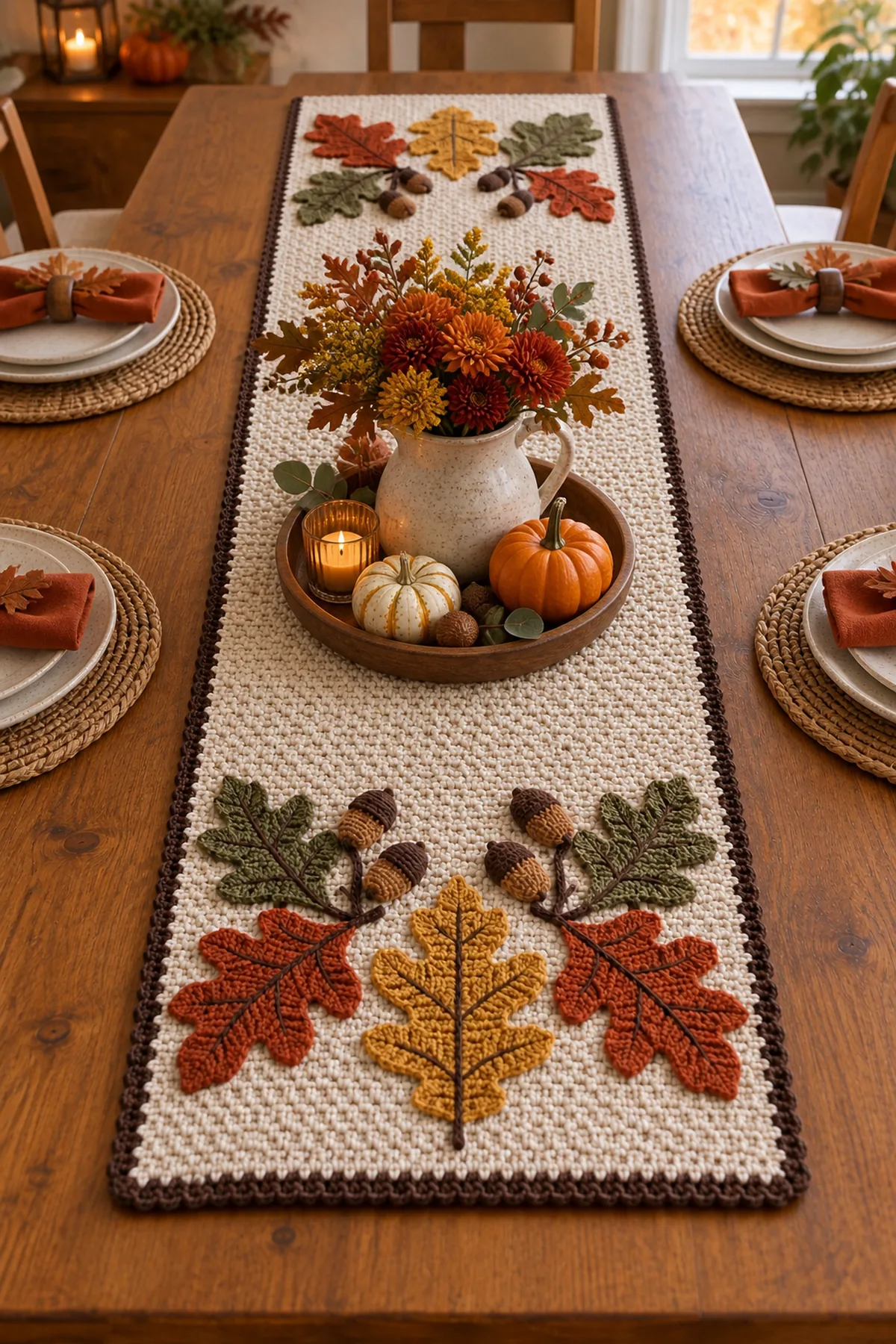
- Position the two motif clusters as mirror images and keep the central 18 inches clear.
Instructions
Work the Lengthwise Linen-Stitch Base
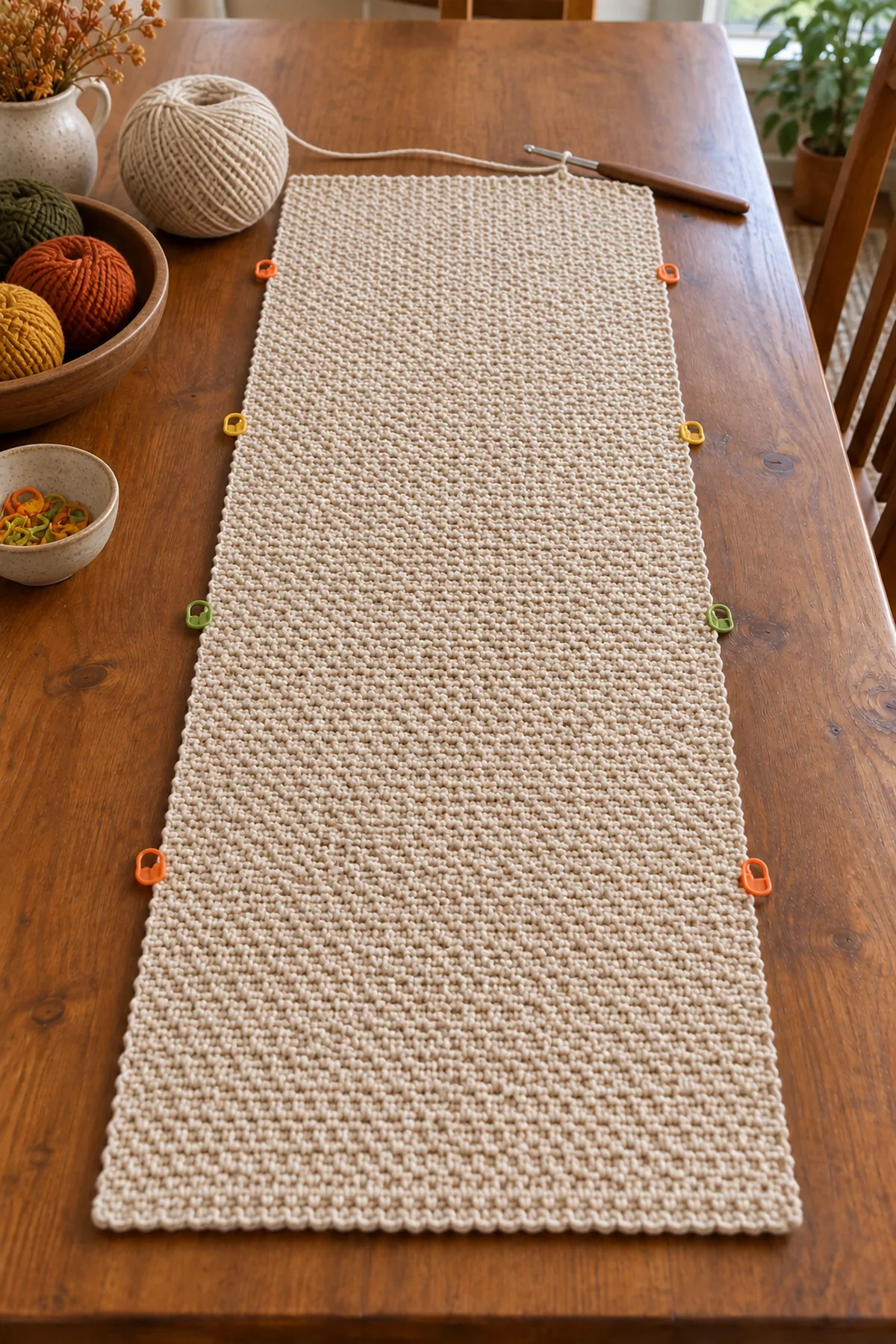
Use oatmeal and place markers every 30 positions across the long foundation.
- Foundation Row: Ch 182. Sc in the second chain from the hook and in every chain across. Turn. (181 sts)
- Row 1: Ch 1, sc in the first stitch, then repeat [ch 1, skip next stitch, sc in next stitch] 90 times. Turn. (181 positions)
- Rows 2–45: Ch 1, sc in the first stitch, repeat [ch 1, sc in the next chain-1 space] across, and sc in the final stitch. Turn after Rows 2–44. (181 positions)
- Fasten off and block the rectangle to approximately 11.5 by 46.5 inches.
Add the Dark Corded Border
Join brown yarn at a corner with the right side facing.
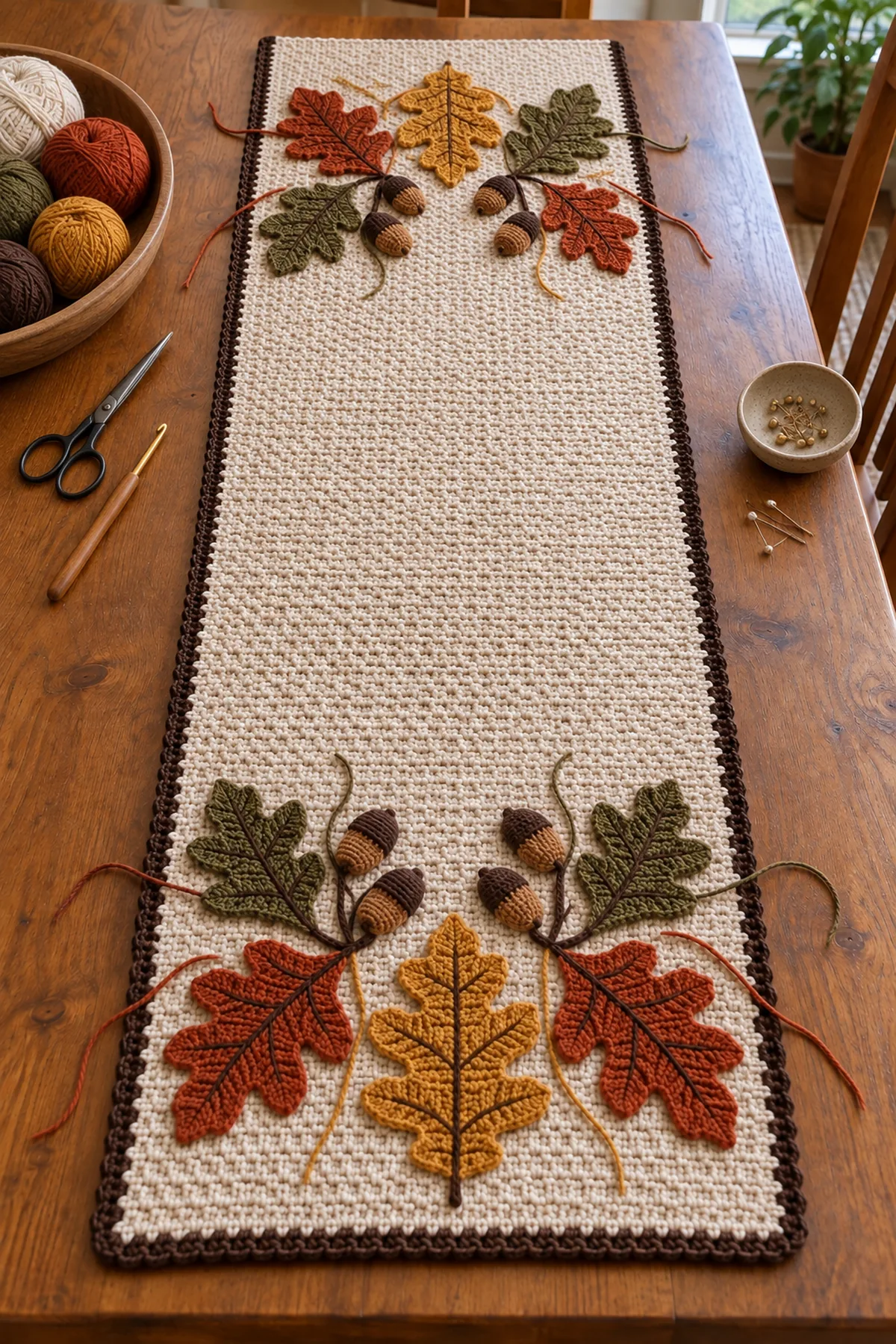
- Border Round 1: Sc evenly around, placing one stitch in every foundation stitch, one stitch in each row end, and 3 sc in every corner.
- Border Round 2: Work reverse sc in every stitch, using one relaxed reverse sc at each corner.
- Join invisibly, fasten off, and block the bordered base to 13 by 48 inches.
Crochet Nine Lobed Oak Leaves
Make three leaves in each autumn shade.
- Ch 15. Sl st in the second chain, then work sc, hdc, dc, tr, dc, hdc, sc, sl st along the chain to form one side of the center spine.
- Working back along the opposite side, make four oak lobes in the marked spaces using the oak-lobe sequence, then work a small pointed tip at the chain end.
- Sl st to the beginning, ch 6 for the stem, sl st back through all 6 chains, and fasten off with an 18-inch sewing tail.
- Steam-block all nine leaves with the center spines straight and lobes open.
Make Acorns and Arrange the End Clusters
Make six acorns and test the mirrored layout before sewing.
- With brown, make a magic ring, work 6 sc into it, and mark the first stitch. (6 sts)
- Round 2: Work 2 sc in each stitch. (12 sts) Rounds 3–4: Sc around. (12 sts)
- Stuff lightly, work sc2tog around to close, then add a 4-chain stem. Make five more.
- Arrange four leaves and three acorns near one end, mirror the cluster at the other end, and place the ninth leaf beside one cluster for a natural asymmetry. Sew only the spines and acorn caps.
Assembly and Shaping
Measure 5 inches inward from each short edge and mark matching cluster zones. Pin the oak-leaf spines first, add acorns between the lower lobes, and verify the center remains clear before sewing through back loops only.
Lay every component on a flat surface before joining. Match the marked centers first, then divide each remaining edge into equal sections. Work through both layers with consistent tension and pause after each section to check that the fabric lies flat. This measured approach prevents twisting and keeps decorative details facing the intended direction.
Finishing
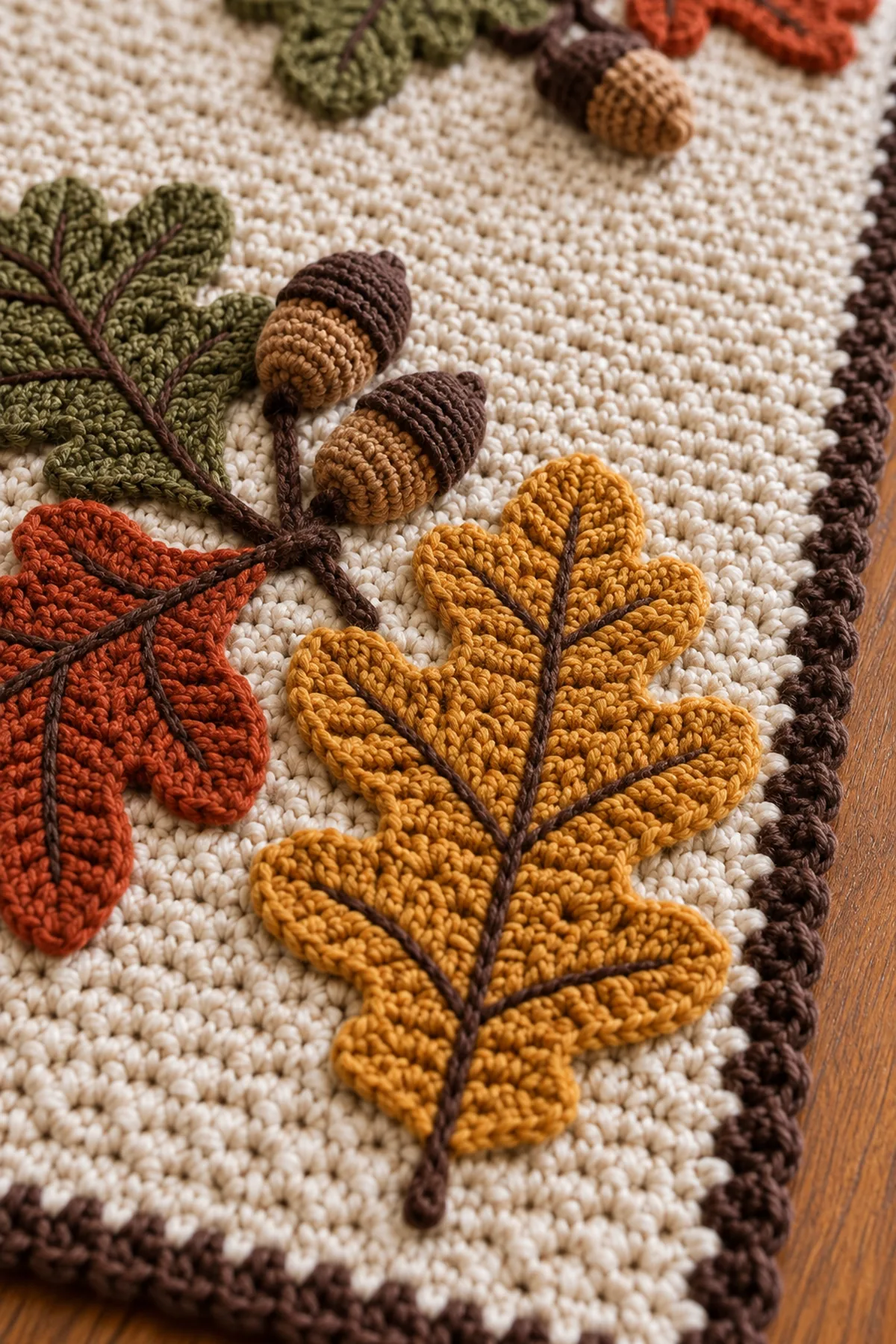
- Weave base and border ends into matching stitches.
- Secure each leaf along its spine while leaving all lobe tips raised.
- Anchor each acorn cap firmly and hide the tail beneath the motif.
- Mist the runner, square the border, and let the motif clusters dry without flattening them.
For a polished result, weave each tail through several same-color stitches, reverse direction once, and trim only after the fabric has been gently stretched. Block to the listed dimensions without flattening textured stitches. Inspect joins, borders, straps, and decorative pieces before the project is used or gifted.
Helpful Tips
- Use a larger hook only for the long foundation chain if it tends to tighten.
- Label the two cluster layouts before lifting the motifs to sew.
- Alternate leaf colors rather than grouping identical shades.
- Use cotton so the long base blocks cleanly and remains stable on the table.
Good lighting and a contrasting stitch marker make counting much easier. If a section looks uneven, compare the current count with the previous checkpoint before continuing. Fixing one missed stitch early is faster than compensating later, and it preserves the measurements used by the assembly instructions.
Frequently Asked Questions
How is this different from a maple-leaf runner?
This design uses a lengthwise linen-stitch base, rounded lobed oak leaves, acorns, mirrored end clusters, and a reverse-single-crochet edge.
Can I shorten the runner?
Yes. Remove foundation positions in pairs, keep an odd total, and preserve at least 18 clear inches between the end clusters.
Do I have to sew every leaf edge?
No. Sew the spine and lower lobes only so the outer points keep their natural dimension.
Conclusion
The finished oak-leaf runner combines a calm woven base with unmistakable lobed foliage, tiny acorns, and a dark corded outline. Its lengthwise construction and mirrored clusters make it structurally and visually distinct from the diagonal maple-leaf design.
Printable Crochet Pattern Card
Project: Crochet Fall Oak Leaf Table Runner
Skill level: Intermediate Hook: 4.5 mm Yarn: Worsted
Finished size: Approximately 13 inches wide by 48 inches long
Card Materials
- Approximately 720 yards oatmeal worsted-weight cotton yarn
- Approximately 110 yards rust cotton yarn
- Approximately 90 yards golden ochre cotton yarn
- Approximately 75 yards olive cotton yarn
- Approximately 45 yards dark brown cotton yarn
- 4.5 mm crochet hook
- Twelve locking stitch markers
- Yarn needle
- Scissors
- Tape measure
Card Instructions
- Work the Lengthwise Linen-Stitch Base: Work a 181-position oatmeal linen-stitch rectangle lengthwise for 45 rows and block it square.
- Add the Dark Corded Border: Add one balanced single-crochet round and one dark reverse-single-crochet round.
- Crochet Nine Lobed Oak Leaves: Make nine deeply lobed oak leaves in rust, ochre, and olive and block their points open.
- Make Acorns and Arrange the End Clusters: Crochet six tiny acorns and secure them with nine oak leaves in balanced end clusters.
Finish: Check every count, weave in all ends, block to measurement, and inspect each join.