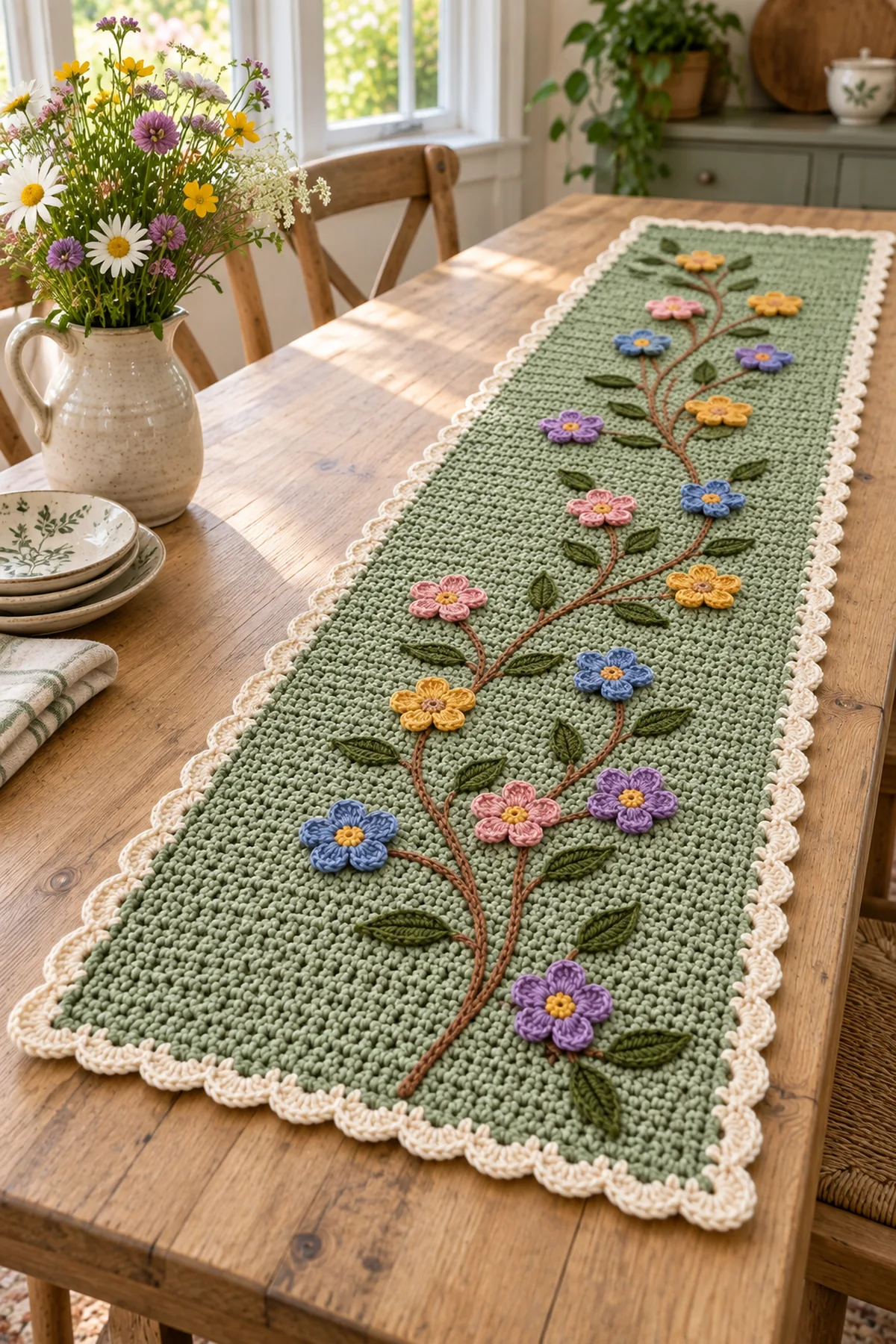
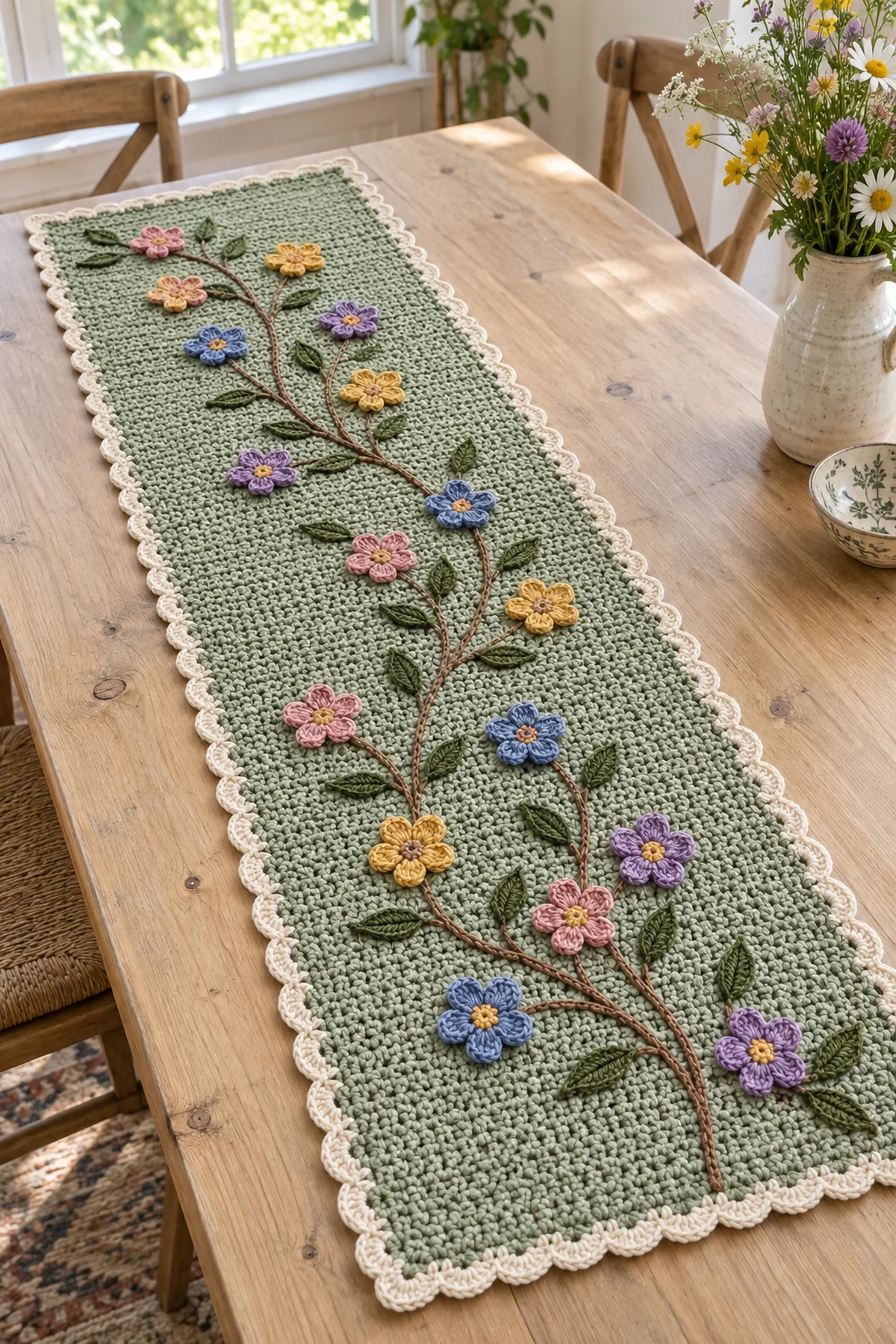
This crochet wildflower meadow table runner turns a quiet sage linen-stitch background into a loose garden path. Three surface-crochet stems wander across the long base, carrying eighteen small flowers in four colors and twenty-four narrow leaves.
Work a 56-position sage linen-stitch rectangle for 144 rows, frame it with ivory scallops, then add three brown surface-crochet stems. Make eighteen five-petal flowers and twenty-four leaves and arrange them with open space between clusters.
Why You’ll Love This Project
The base uses one soothing repeat, while the small motifs are portable and quick. Uneven flower spacing creates a natural meadow effect and keeps this runner visually distinct from formal single-flower arrangements.
Materials
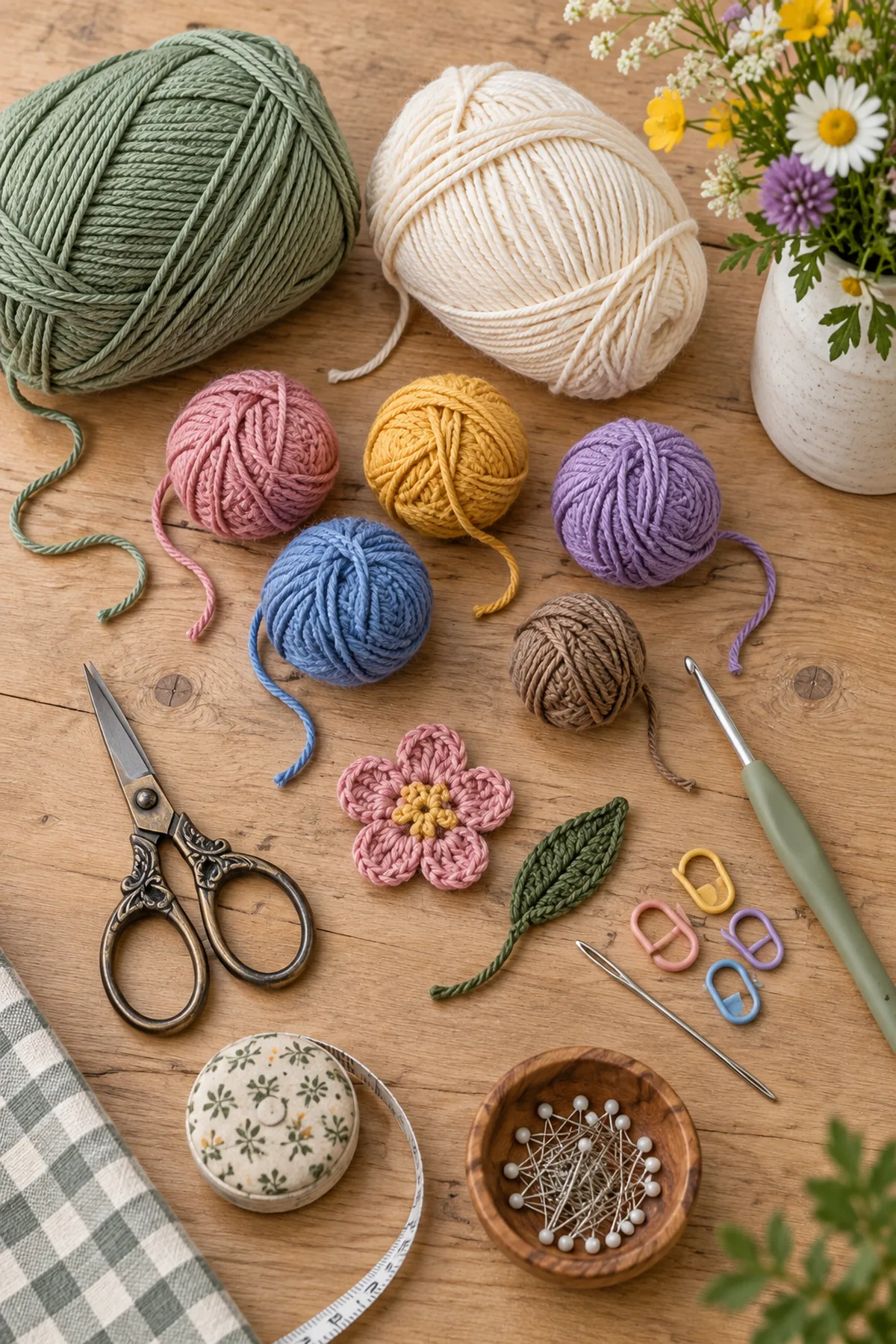
- Approximately 720 yards sage-green worsted-weight cotton yarn
- Approximately 130 yards ivory cotton yarn
- Approximately 30 yards soft brown cotton yarn
- Approximately 25 yards each dusty pink, golden yellow, lavender, and cornflower-blue cotton yarn
- 4 mm crochet hook
- Twelve locking stitch markers
- Yarn needle
- Scissors
- Tape measure
- Blocking mats and rustproof pins
Gauge, Measurements, and Planning
Twenty-eight linen-stitch positions should measure 8 inches and 24 rows should measure 8 inches. The 56 positions and 144 rows plus the border finish close to 16 by 50 inches.
Make and wash a gauge swatch before beginning. Measure only after the swatch is completely dry. If the stitch width differs, change hook size rather than pulling the working yarn tighter. Keep a written count at the end of every section so the finished edges remain balanced and the assembly points line up.
Abbreviations and Special Stitches
- ch: chain
- dc: double crochet
- hdc: half double crochet
- sc: single crochet
- sl st: slip stitch
- st(s): stitch(es)
- BLO: back loop only
- yo: yarn over
Special stitch guidance: Linen stitch: sc in the next chain-1 space, ch 1, and skip the next sc. Flower petal: ch 3, work 2 dc together into the ring, ch 3, and slip stitch into the ring. Scallop: work 5 dc in one marked stitch.
Before You Begin
- Maintain 56 counted positions across every linen-stitch row.
- Block the base before marking stems.
- Make four pink, five yellow, four lavender, and five blue flowers.
- Sew only motif centers and leaf veins so the edges remain dimensional.
Instructions
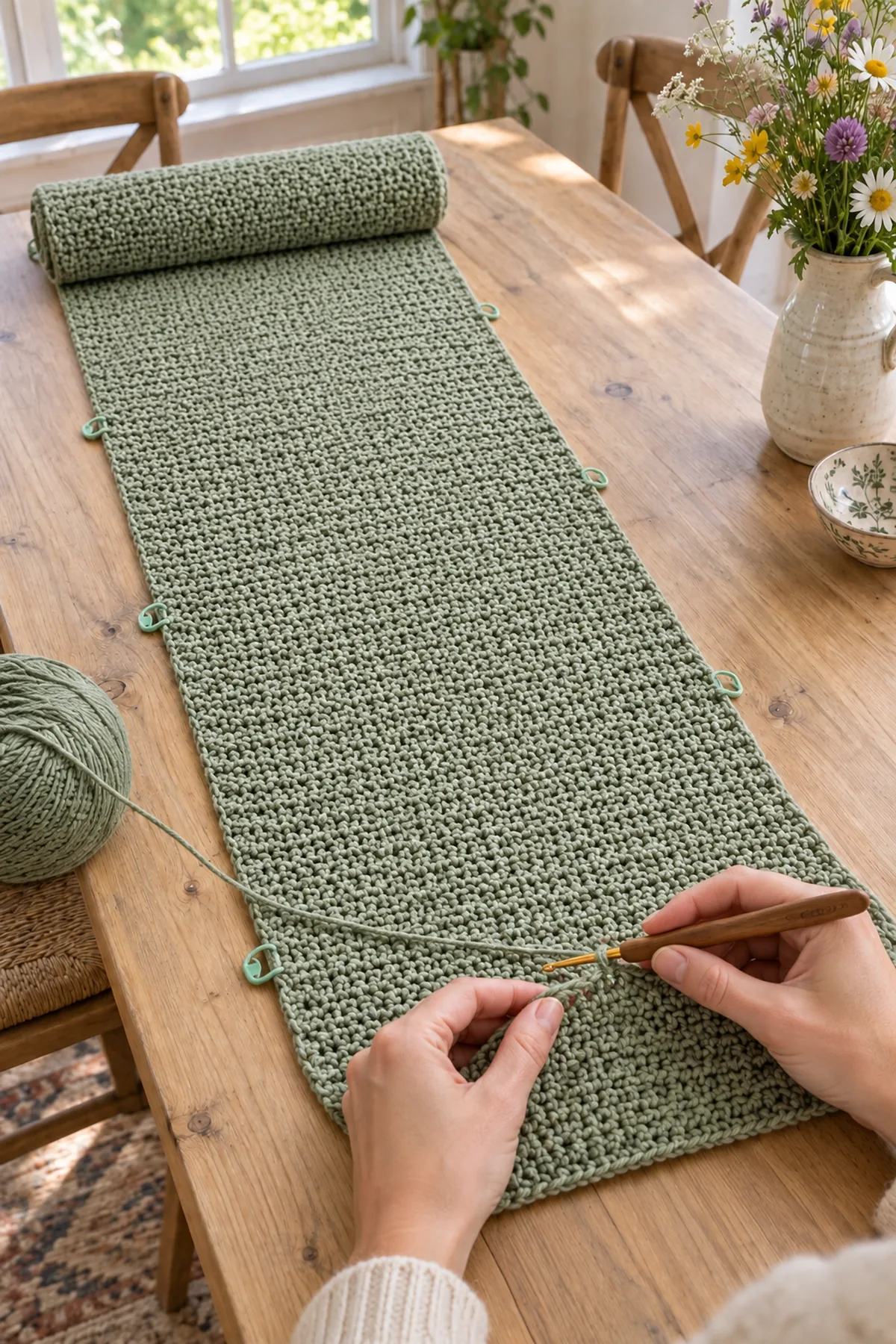
Crochet the Sage Linen-Stitch Base
Use sage yarn and mark both edge positions.
- Foundation Row: Ch 112. Sc in the second chain, then repeat [ch 1, skip 1 chain, sc in next chain] across. Turn. (56 sts)
- Row 1: Ch 1, sc in first stitch, repeat [ch 1, sc in next chain-1 space] across, ending with sc in the final stitch. Turn. (56 positions)
- Rows 2–144: Repeat Row 1, maintaining 56 positions.
- Fasten off and block the base to approximately 15 by 49 inches.
Add the Ivory Meadow Border
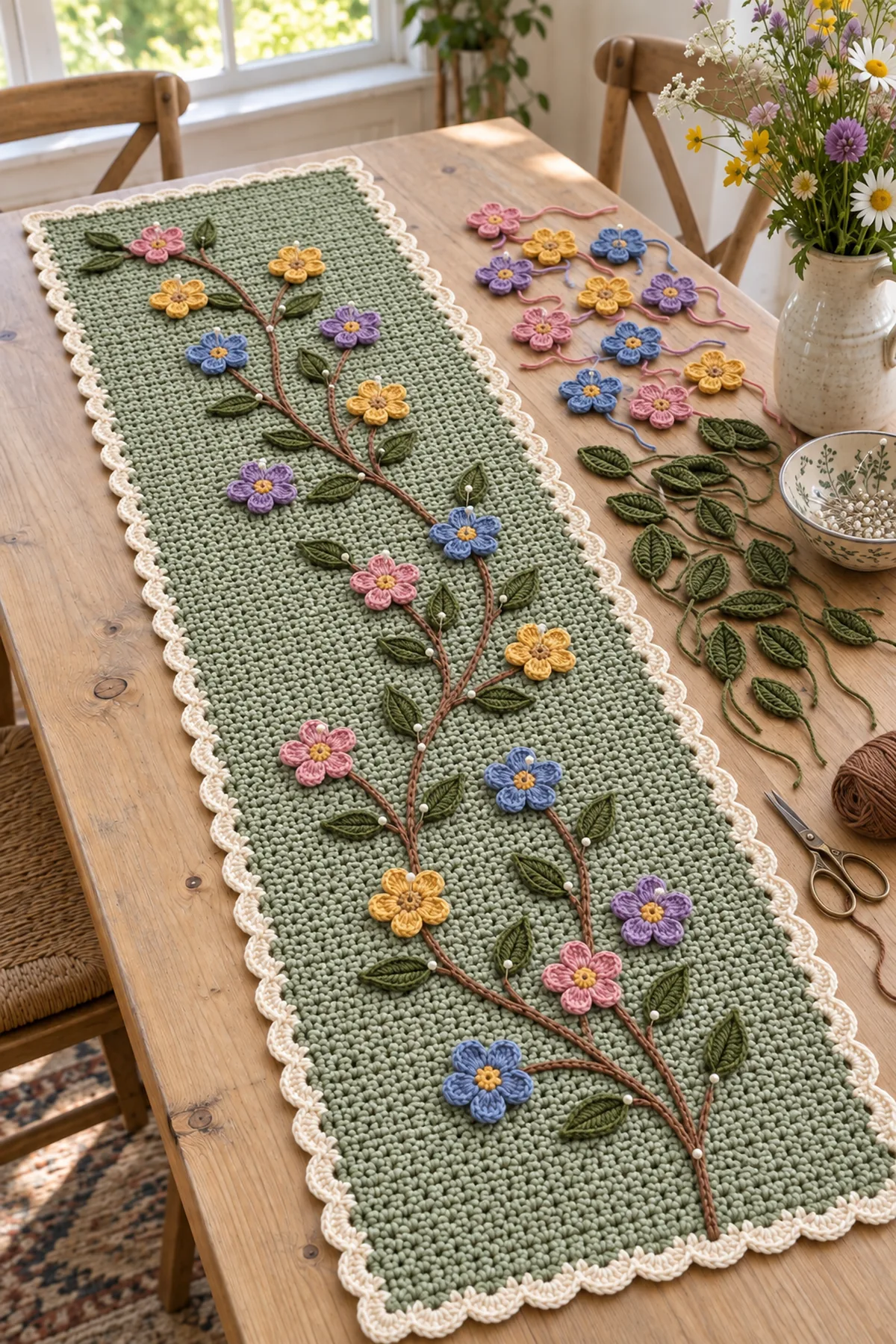
Stabilize all four sides before adding scallops.
- Border Round 1: Join ivory and sc evenly around, placing 3 sc in every corner.
- Border Round 2: Sc in every stitch with 3 sc in each corner.
- Border Round 3: Repeat [skip 1 stitch, 5 dc in next stitch, skip 1 stitch, sl st in next stitch] around, adjusting only at corners.
- Join invisibly and block the bordered base flat.
Draw Three Wandering Meadow Stems
Use removable markers to map three loose paths.
- Mark one 38-inch main path and two shorter 18-inch branches without touching the border.
- With brown, surface-slip-stitch along each marked path.
- Add eight short side twigs at irregular intervals.
- Secure every stem end on the wrong side and steam lightly.
Make and Attach the Wildflowers
Create eighteen flowers and twenty-four leaves before sewing.
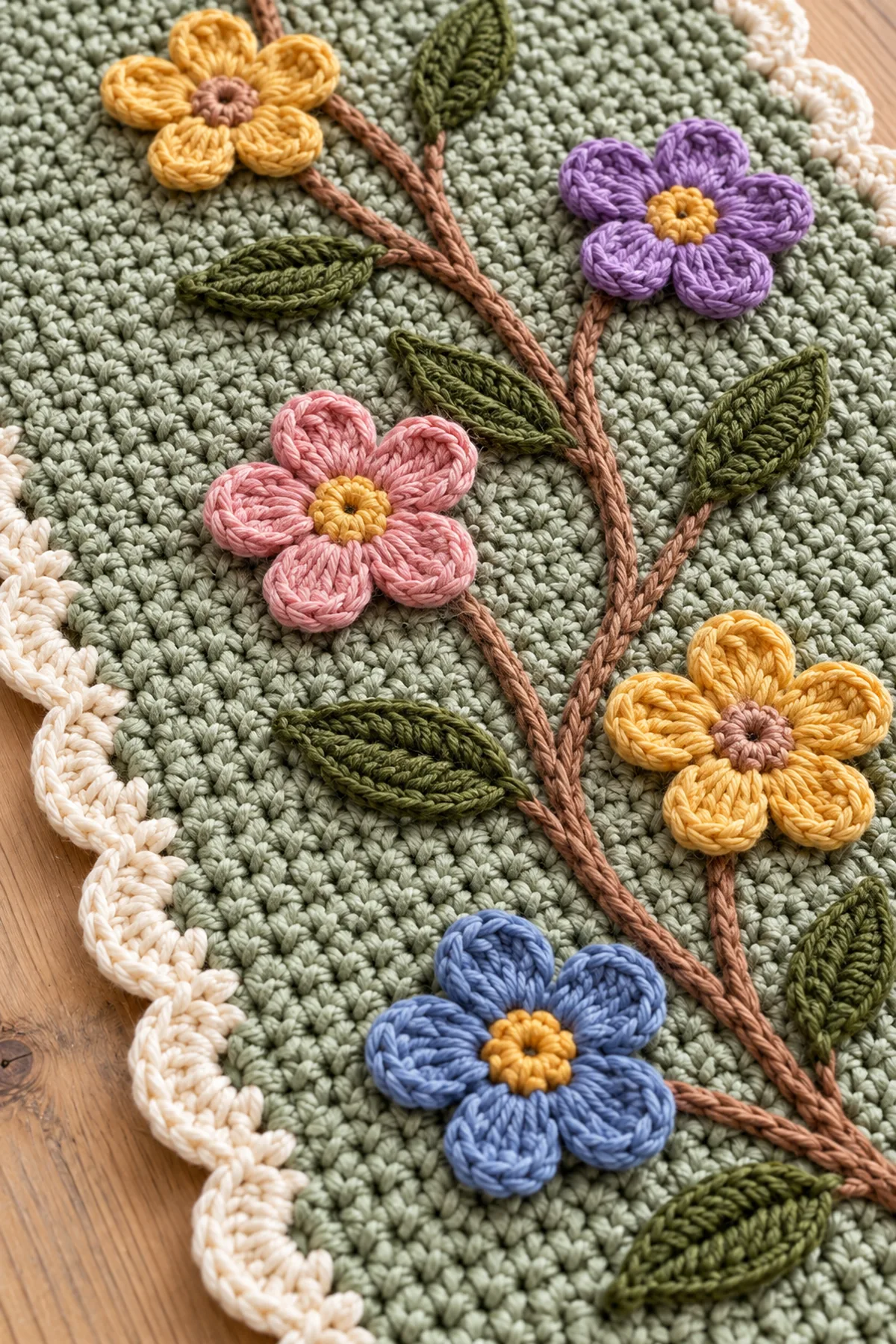
- For each flower, make a magic ring and repeat the five-petal sequence five times; close the ring and leave a tail.
- Make eighteen flowers in the stated color counts, each approximately 2 inches across.
- For each leaf, ch 8 and mirror sc, hdc, 3 dc, hdc, sc along both sides. Make twenty-four.
- Pin flowers in loose groups of two and three, distribute the leaves, and sew only centers and veins.
Assembly and Shaping
Place the longest stem diagonally and cross it with two shorter branches. Keep flower clusters asymmetrical, leave at least 3 inches of open sage background between groups, and keep motifs 1 inch inside the border.
Lay every component on a flat surface before joining. Match the marked centers first, then divide each remaining edge into equal sections. Work through both layers with consistent tension and pause after each section to check that the fabric lies flat. This measured approach prevents twisting and keeps decorative details facing the intended direction.
Finishing
- Weave base ends through matching linen-stitch spaces.
- Secure surface stems at every turn.
- Sew flowers through their center rings twice.
- Mist-block to 16 by 50 inches and lift petals while damp.
For a polished result, weave each tail through several same-color stitches, reverse direction once, and trim only after the fabric has been gently stretched. Block to the listed dimensions without flattening textured stitches. Inspect joins, borders, straps, and decorative pieces before the project is used or gifted.
Helpful Tips
- Mark the full layout before sewing.
- Alternate flower colors rather than forming stripes.
- Use relaxed surface stitches so the base stays flat.
- Count all eighteen flowers and twenty-four leaves before finishing.
Good lighting and a contrasting stitch marker make counting much easier. If a section looks uneven, compare the current count with the previous checkpoint before continuing. Fixing one missed stitch early is faster than compensating later, and it preserves the measurements used by the assembly instructions.
Frequently Asked Questions
Can I use fewer flower colors?
Yes. Use two harmonious colors while preserving the eighteen-flower count and irregular spacing.
Why is my runner narrowing?
The linen-stitch edge positions are being missed. Mark the first and last counted position of every row.
Can I lengthen the runner?
Add linen-stitch rows in pairs before the border, then extend only the longest stem.
Conclusion
The completed wildflower runner pairs a calm sage field with three loose stems and eighteen colorful blooms. Its scattered meadow rhythm and cream scallops create a relaxed botanical design with a construction all its own.
Printable Crochet Pattern Card
Project: Crochet Wildflower Meadow Table Runner
Skill level: Intermediate Hook: 4 mm Yarn: Worsted
Finished size: Approximately 16 inches wide by 50 inches long
Card Materials
- Approximately 720 yards sage-green worsted-weight cotton yarn
- Approximately 130 yards ivory cotton yarn
- Approximately 30 yards soft brown cotton yarn
- Approximately 25 yards each dusty pink, golden yellow, lavender, and cornflower-blue cotton yarn
- 4 mm crochet hook
- Twelve locking stitch markers
- Yarn needle
- Scissors
- Tape measure
- Blocking mats and rustproof pins
Card Instructions
- Crochet the Sage Linen-Stitch Base: Work a 56-position sage linen-stitch rectangle for 144 rows.
- Add the Ivory Meadow Border: Add two stabilizing ivory rounds and a measured scalloped edge.
- Draw Three Wandering Meadow Stems: Surface-crochet three wandering brown stems with eight short twigs.
- Make and Attach the Wildflowers: Make eighteen five-petal flowers and twenty-four leaves and attach them in loose meadow clusters.
Finish: Check every count, weave in all ends, block to measurement, and inspect each join.