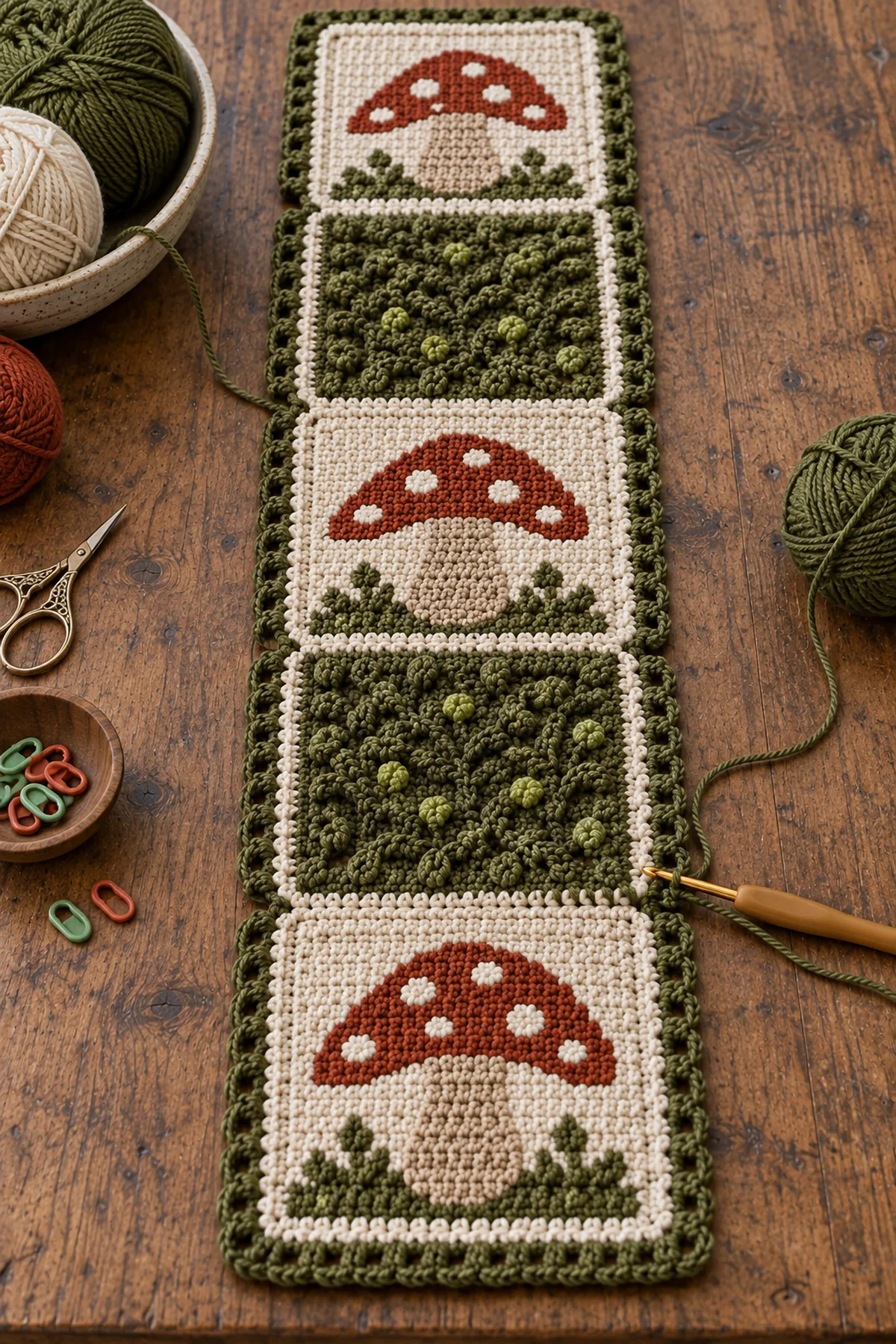
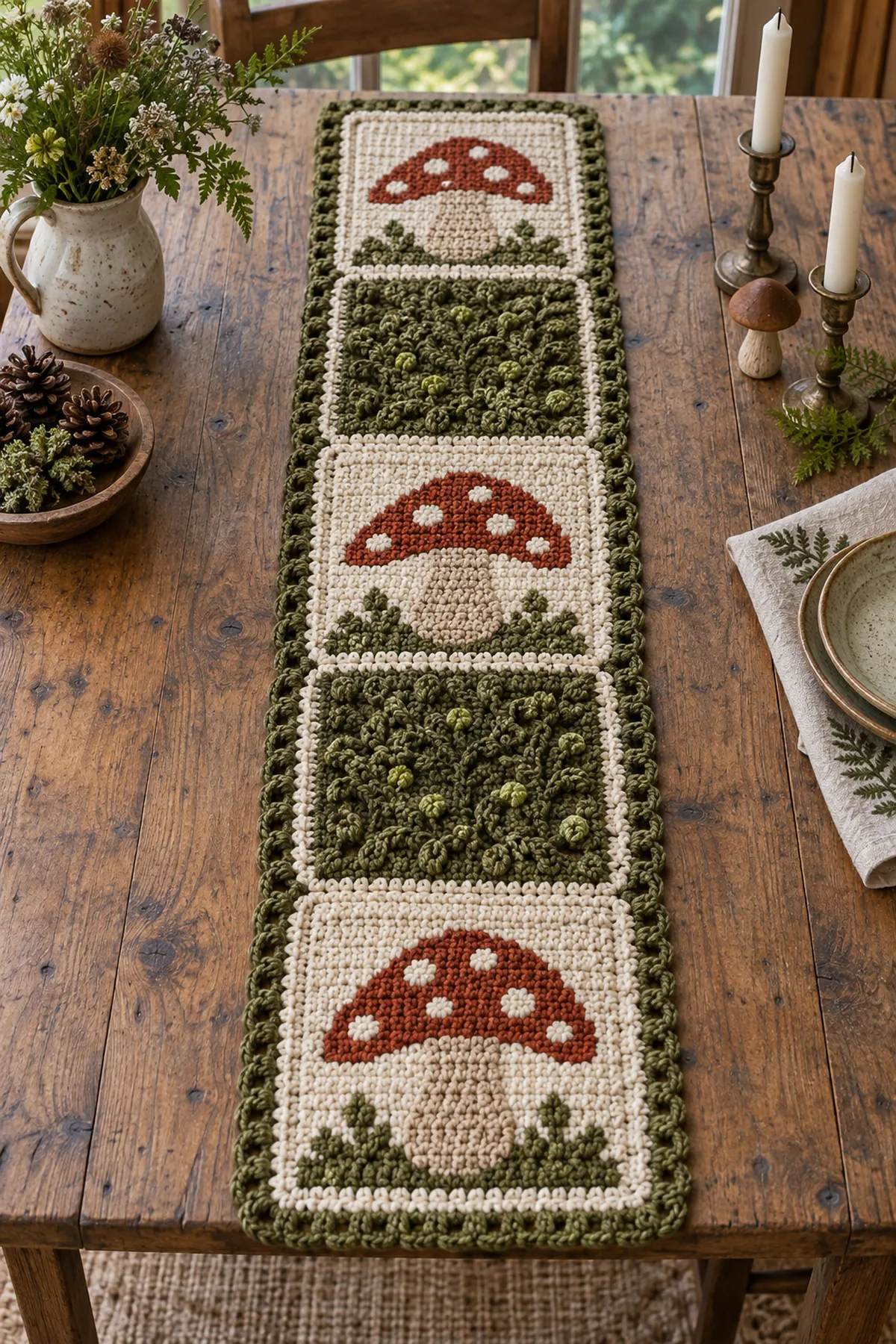
This crochet woodland mushroom table runner is constructed as a line of five rectangular panels rather than one long fabric or a field of appliqués. Three panels contain counted tapestry mushrooms with rust caps and cream spots, while two textured green panels create quiet mossy breaks.
Work five 28-stitch panels for 36 rows each: three colorwork mushroom panels and two solid moss-texture panels. Block every piece to the same 8-by-9-inch size, seam the short edges into a 45-inch strip, then add cream side bands and an olive loop-stitch border.
Why You’ll Love This Project
Small panels keep the colorwork manageable and make corrections local. Alternating pictures and texture create a storybook woodland rhythm, while the end-to-end construction, side bands, and looped edge are unlike the other runners in this batch.
Materials
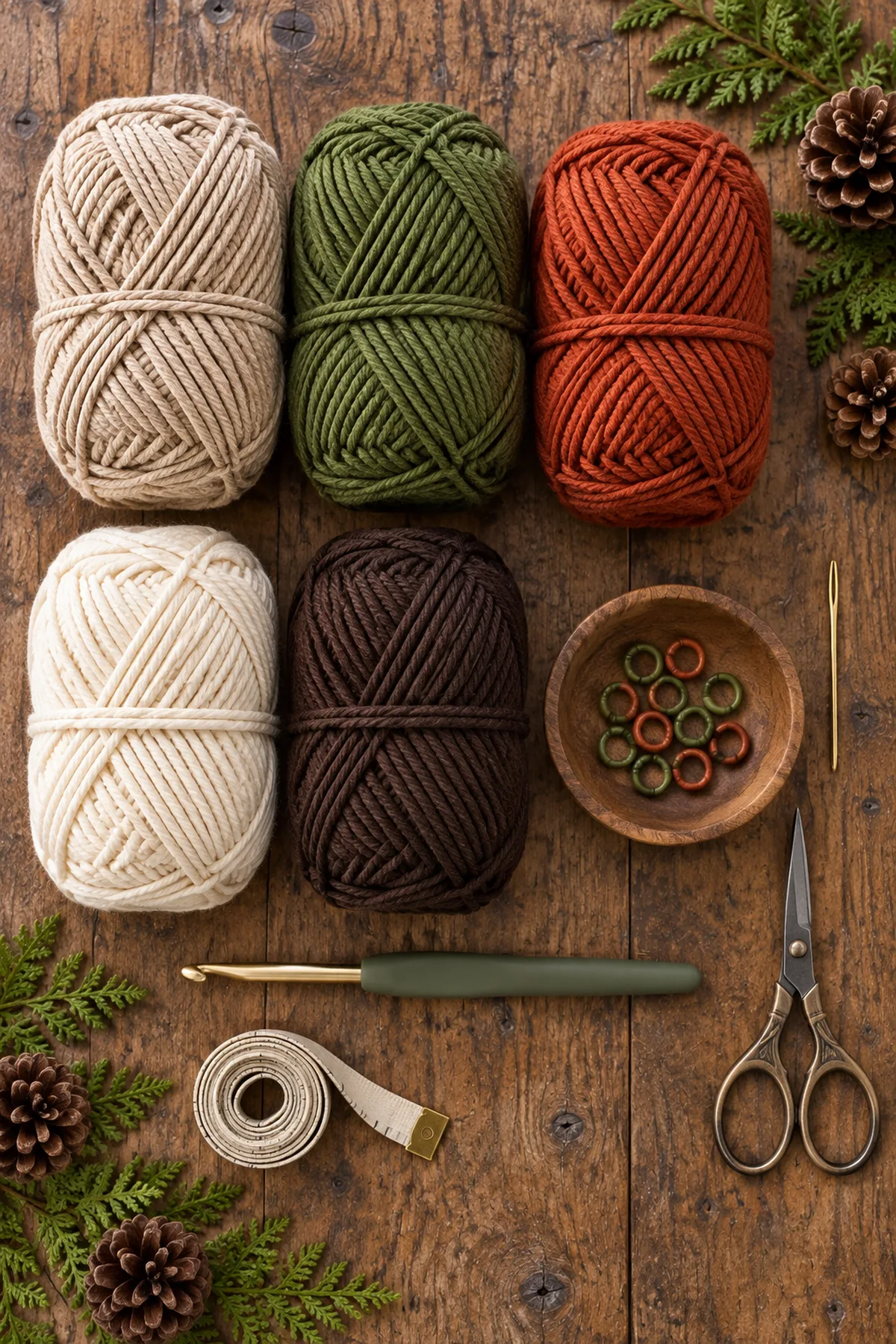
- Approximately 430 yards oatmeal worsted-weight cotton yarn
- Approximately 210 yards moss green cotton yarn
- Approximately 150 yards rust cotton yarn
- Approximately 45 yards cream cotton yarn for cap spots
- Approximately 35 yards dark brown cotton yarn
- 4 mm crochet hook
- Ten locking stitch markers
- Yarn needle
- Scissors
- Tape measure
Gauge, Measurements, and Planning
Fourteen single crochet stitches and 16 rows should measure 4 inches. Each 28-stitch by 36-row panel blocks to approximately 8 by 9 inches; five joined panels plus the end border finish close to 48 inches.
Make and wash a gauge swatch before beginning. Measure only after the swatch is completely dry. If the stitch width differs, change hook size rather than pulling the working yarn tighter. Keep a written count at the end of every section so the finished edges remain balanced and the assembly points line up.
Abbreviations and Special Stitches
- ch: chain
- dc: double crochet
- hdc: half double crochet
- sc: single crochet
- sl st: slip stitch
- st(s): stitch(es)
- BLO: back loop only
Special stitch guidance: Tapestry color change: complete the last yarn-over of the previous stitch with the new color and carry the unused strand inside the following stitches. Loop stitch: wrap yarn around a finger, insert the hook, catch both strands, and complete one sc while holding the loop.
Before You Begin
- Read colorwork rows from right to left on right-side rows and left to right on wrong-side rows.
- Carry only one unused color at a time and embroider the cream cap spots separately.
- Every panel remains 28 stitches wide for all 36 rows.
- Block all five panels to identical measurements before seaming.
Instructions
Crochet Three Tapestry Mushroom Panels
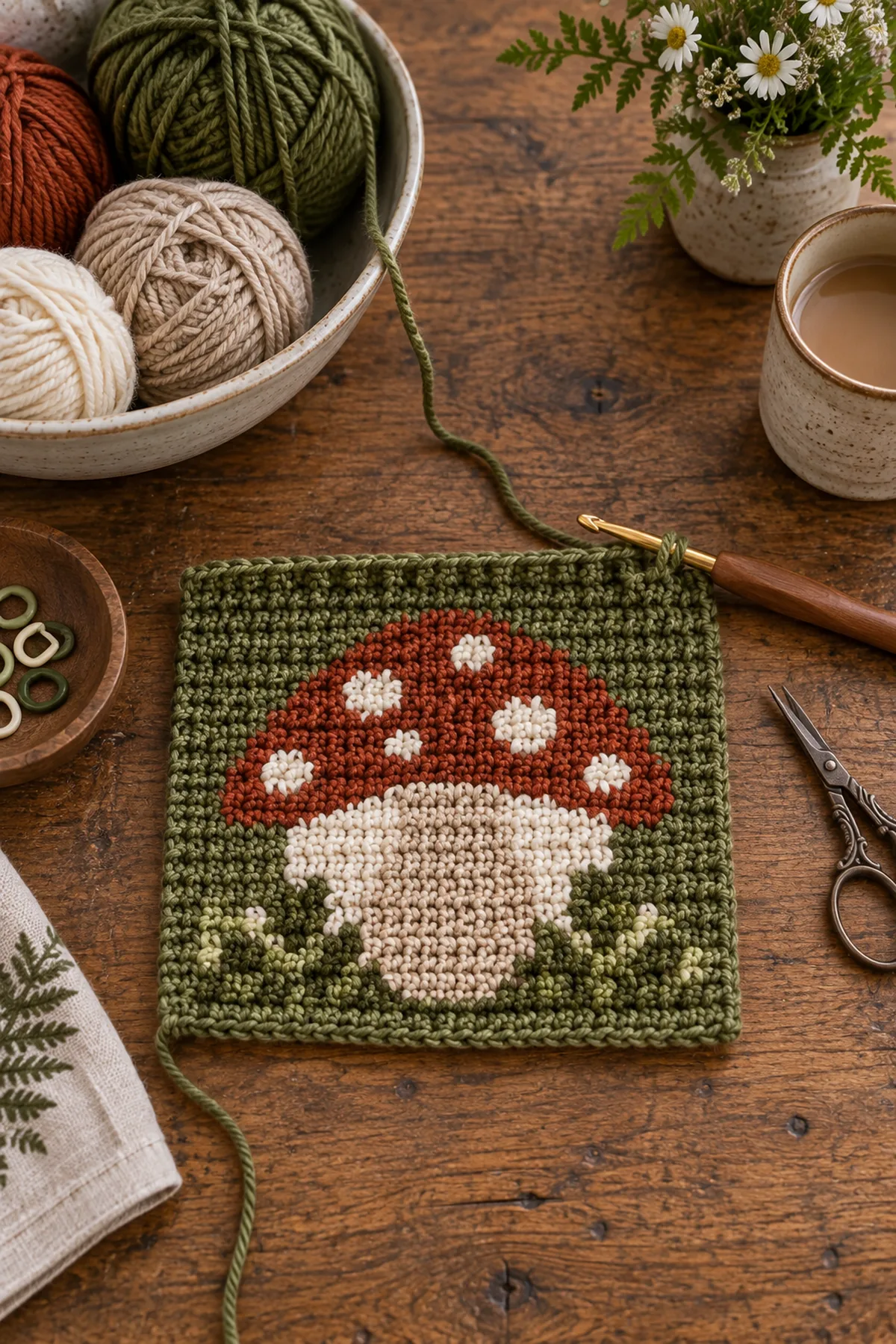
Make three matching 28-stitch panels with a centered rust cap and oatmeal stem.
- Foundation Row: With moss, ch 29. Sc in the second chain and across. Turn. (28 sts)
- Rows 1–8: Ch 1, sc across in moss. Turn. (28 sts)
- Rows 9–11: Work 8 moss, 12 rust, 8 moss. Rows 12–14: Work 5 moss, 18 rust, 5 moss. Rows 15–17: Work 3 moss, 22 rust, 3 moss. (28 sts each row)
- Rows 18–23: Work 11 moss, 6 oatmeal, 11 moss for the stem. Rows 24–36: Work 28 moss. Fasten off.
- Embroider seven small cream spots across the cap and make two more matching mushroom panels.
Crochet Two Moss-Texture Panels
Use moss green and a raised alternating-loop texture.
- Ch 29. Sc in the second chain and across. Turn. (28 sts)
- Odd Rows 1–35: Ch 1, sc in the BLO of every stitch. Turn. (28 sts)
- Even Rows 2–36: Ch 1, sc in the front loop of every stitch. Turn. (28 sts)
- Fasten off and make a second identical panel.
Join the Five-Panel Woodland Strip
Alternate mushroom and moss panels from one end to the other.
- Block every panel to exactly 8 by 9 inches and mark both short-edge centers.
- Arrange mushroom, moss, mushroom, moss, mushroom with all right sides facing up.
- Whipstitch each pair of short edges through both loops, matching centers and corners first.
- Steam the four seams from the wrong side and measure the strip before adding side bands.
Add Side Bands and Forest Loop Edging
Use oatmeal to widen the strip and moss yarn for the final soft edge.
- Join oatmeal at one long edge and work 6 rows of sc evenly from end to end. Repeat on the opposite long edge.
- Work one sc round around the entire runner, placing 3 sc in each corner.
- Work loop stitch along both long edges and ordinary sc across both short edges.
- Fasten off and block the completed runner to 12 by 48 inches.
Assembly and Shaping
Alternate the five panels exactly as listed and join only after each piece measures 8 by 9 inches. Keep mushroom caps upright in one viewing direction, align the short-edge centers, and add equal-width cream bands to both long sides.
Lay every component on a flat surface before joining. Match the marked centers first, then divide each remaining edge into equal sections. Work through both layers with consistent tension and pause after each section to check that the fabric lies flat. This measured approach prevents twisting and keeps decorative details facing the intended direction.
Finishing
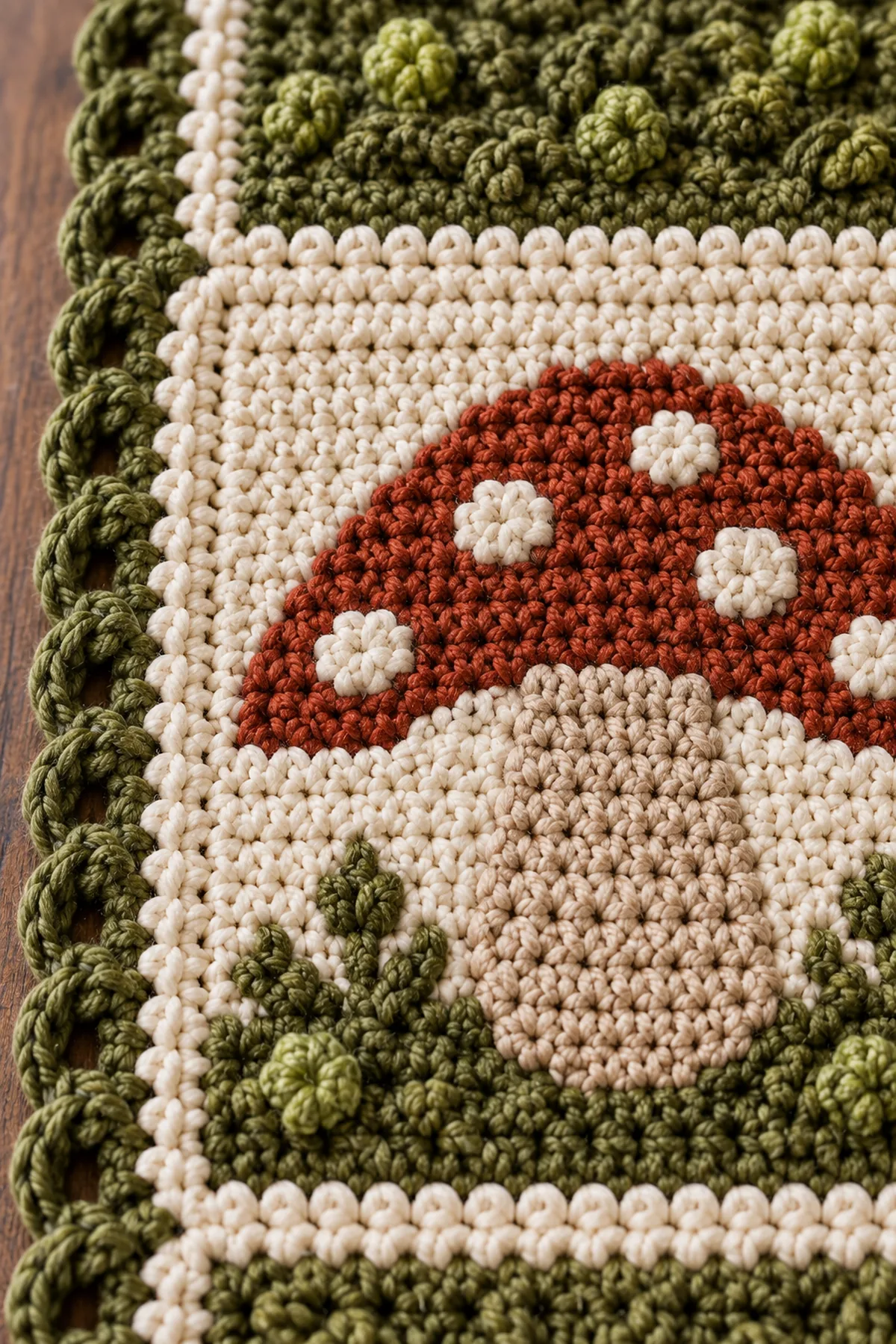
- Weave color-change tails horizontally inside matching tapestry rows.
- Secure embroidered cap spots on the wrong side without knots that create bumps.
- Reinforce the four panel seams at both long edges.
- Comb the loop-stitch edge gently and block the center panels flat.
For a polished result, weave each tail through several same-color stitches, reverse direction once, and trim only after the fabric has been gently stretched. Block to the listed dimensions without flattening textured stitches. Inspect joins, borders, straps, and decorative pieces before the project is used or gifted.
Helpful Tips
- Use separate short cream strands for spots instead of carrying cream across the cap.
- Count all 28 stitches after every colorwork row.
- Keep carried yarn relaxed so the mushroom panels do not narrow.
- Place the moss panels between mushroom panels before sewing to confirm the intended rhythm.
Good lighting and a contrasting stitch marker make counting much easier. If a section looks uneven, compare the current count with the previous checkpoint before continuing. Fixing one missed stitch early is faster than compensating later, and it preserves the measurements used by the assembly instructions.
Frequently Asked Questions
Can I change the mushroom cap color?
Yes. Keep the same counted 12-, 18-, and 22-stitch cap widths so the silhouette remains balanced.
Why is my tapestry panel puckering?
The carried strand is too tight. Spread the last several stitches along the strand before completing each color block.
Can I lengthen the runner?
Add one moss panel and one mushroom panel as a pair, then keep all panels at the same blocked size.
Conclusion
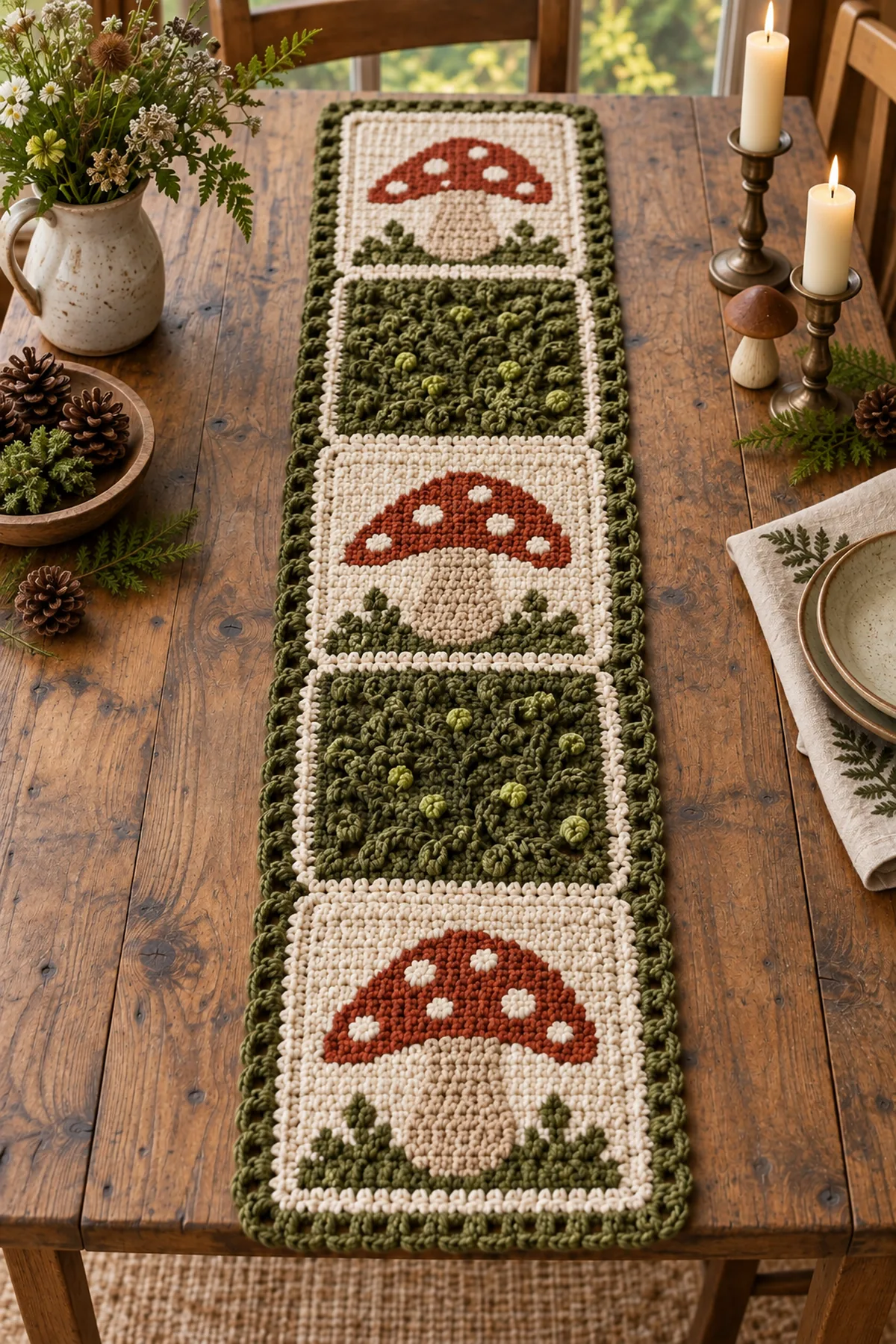
The finished woodland mushroom runner reads as a line of five storybook panels rather than a decorated rectangle. Tapestry caps, alternating moss texture, cream side bands, and a looped forest edge create an unmistakably different construction.
Printable Crochet Pattern Card
Project: Crochet Woodland Mushroom Table Runner
Skill level: Intermediate Hook: 4 mm Yarn: Worsted
Finished size: Approximately 12 inches wide by 48 inches long
Card Materials
- Approximately 430 yards oatmeal worsted-weight cotton yarn
- Approximately 210 yards moss green cotton yarn
- Approximately 150 yards rust cotton yarn
- Approximately 45 yards cream cotton yarn for cap spots
- Approximately 35 yards dark brown cotton yarn
- 4 mm crochet hook
- Ten locking stitch markers
- Yarn needle
- Scissors
- Tape measure
Card Instructions
- Crochet Three Tapestry Mushroom Panels: Make three 28-stitch, 36-row tapestry panels with rust caps, oatmeal stems, and seven cream spots.
- Crochet Two Moss-Texture Panels: Make two 28-stitch moss panels for 36 rows, alternating back-loop and front-loop texture.
- Join the Five-Panel Woodland Strip: Alternate and seam three mushroom panels with two moss panels into one 45-inch strip.
- Add Side Bands and Forest Loop Edging: Add six-row cream side bands, one stabilizing round, and loop stitch along both long edges.
Finish: Check every count, weave in all ends, block to measurement, and inspect each join.