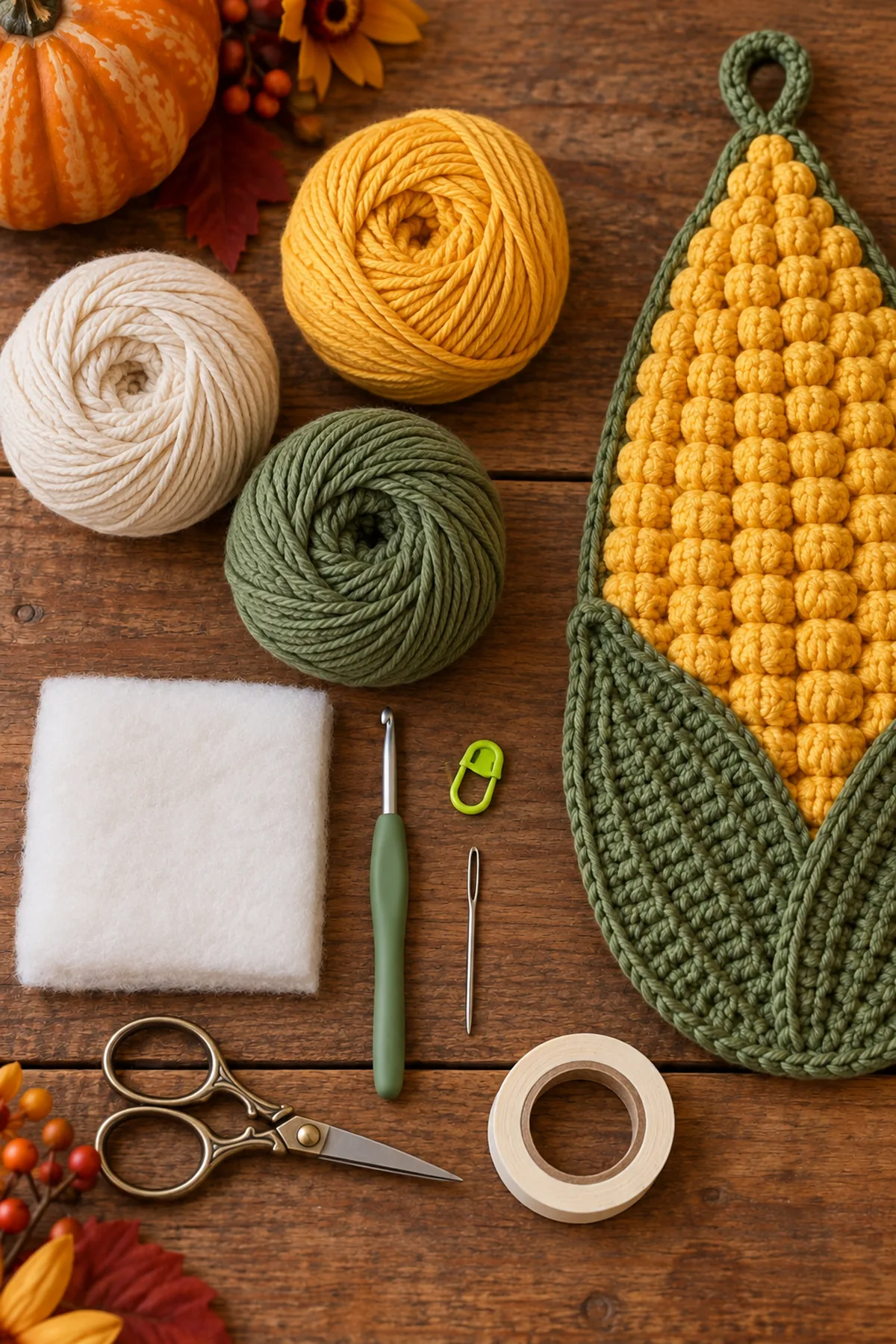
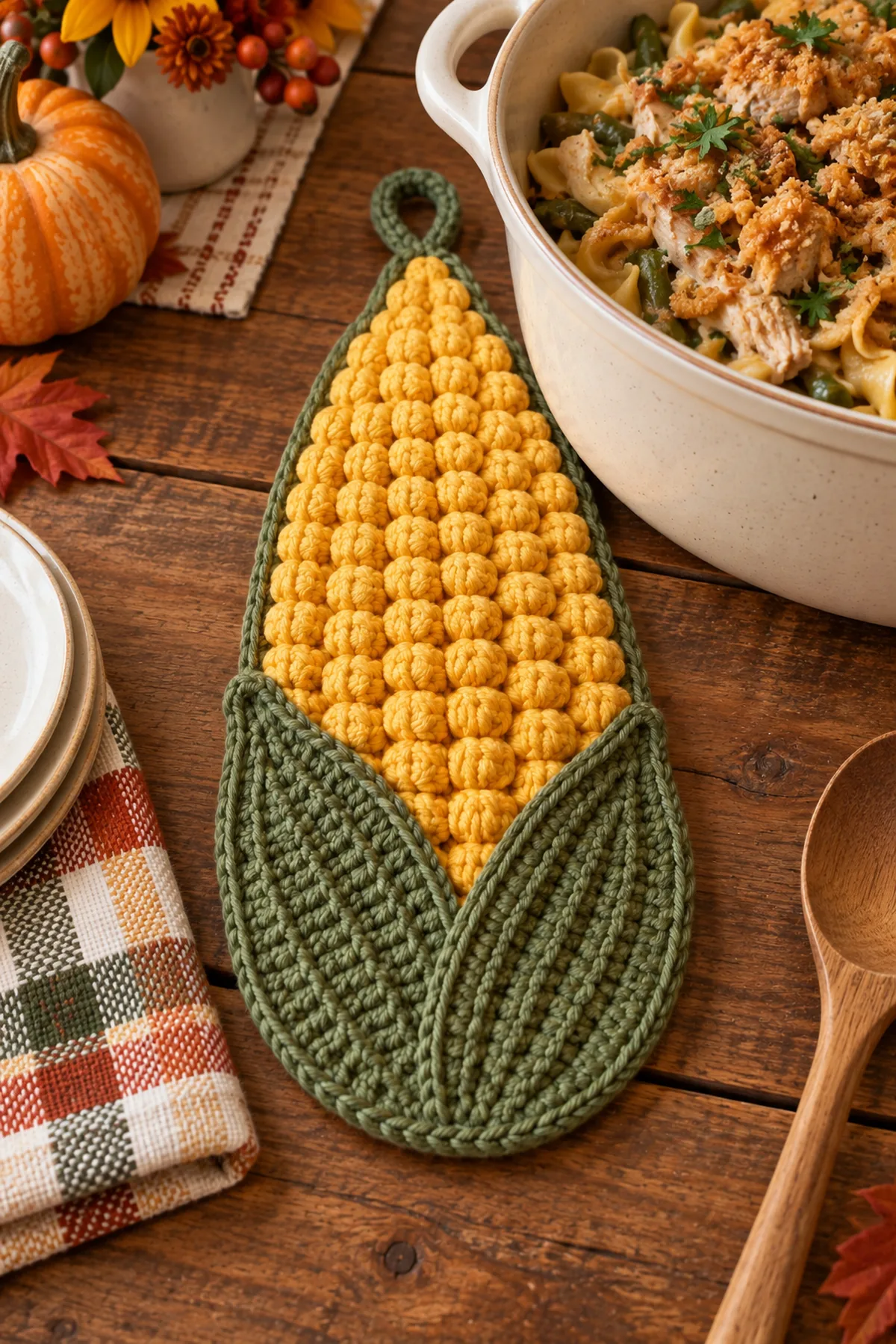
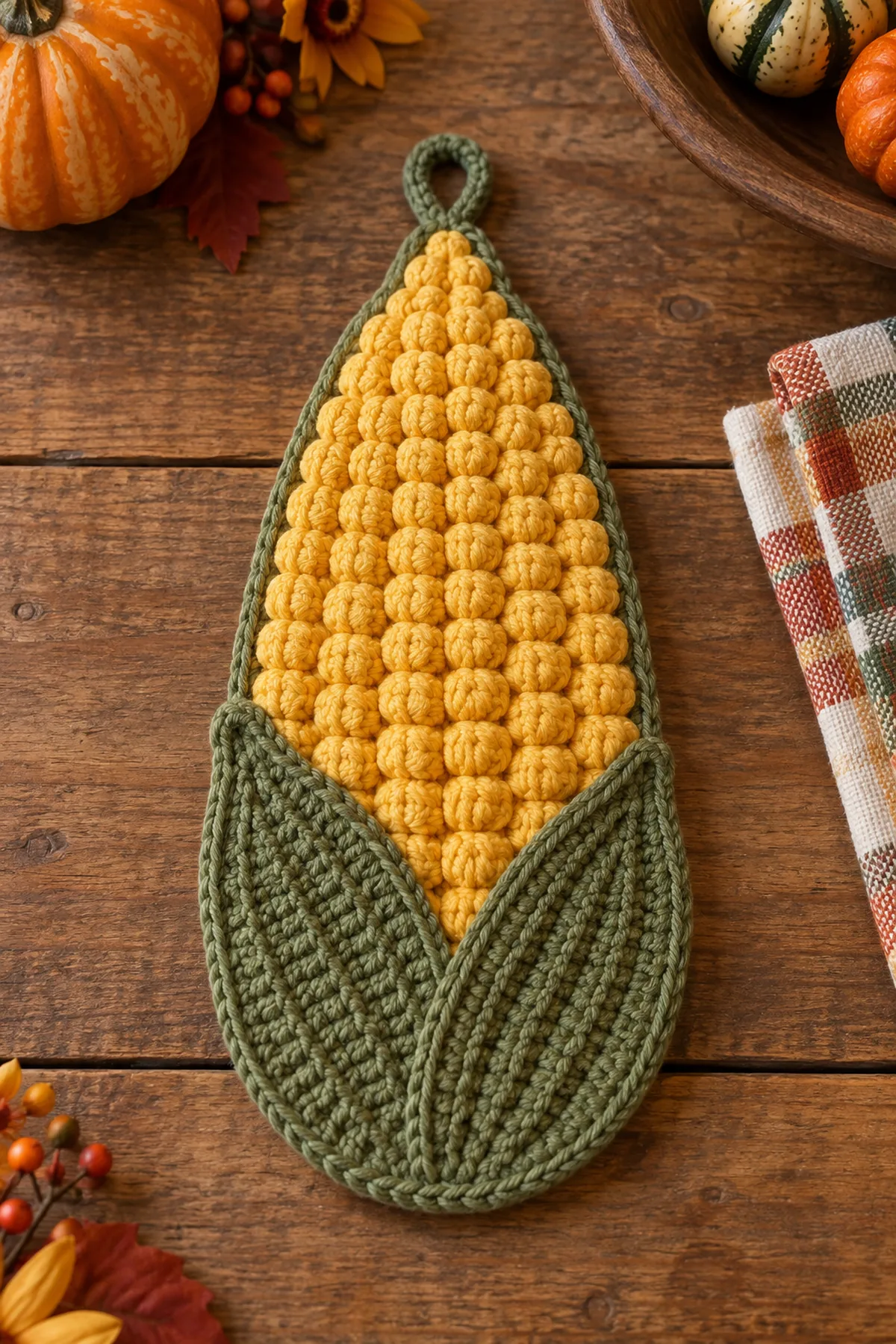
This crochet harvest corn trivet pattern is a thick double-layer harvest corn trivet with a golden bobble-kernel front, flat cream backing, tapered cob shape, overlapping olive husk leaves, and a small hanging loop. The construction is designed specifically for the named project rather than adapted from a generic template.
Two matching tapered cob panels begin with 13-stitch foundations and widen through paired edge increases before narrowing at the tip. The golden front uses staggered bobble kernels, the cream back remains flat, and both layers are joined beneath two olive leaf-shaped husks.
Why You’ll Love This Project
The bobble stitch kernels, shaped rows, double-layer assembly, leaf husk edging create a distinct trivet with clear checkpoints, practical structure, and strong handmade texture.
Materials
- Approximately 120 yards golden-yellow worsted-weight cotton yarn
- Approximately 95 yards cream worsted-weight cotton yarn
- Approximately 55 yards olive worsted-weight cotton yarn
- One locking stitch marker
- Optional 8-inch square of heat-resistant cotton batting
- 4 mm crochet hook
- Yarn needle
- Scissors
- Tape measure
- Blocking mats and rustproof pins
Gauge, Measurements, and Planning
Make a generous swatch in the main stitch. The target gauge is 15 stitches and 14 rows = 4 inches in dense bobble texture; change hook size if needed before beginning the full runner.
Make and wash a gauge swatch before beginning. Measure only after the swatch is completely dry. If the stitch width differs, change hook size rather than pulling the working yarn tighter. Keep a written count at the end of every section so the finished edges remain balanced and the assembly points line up.
Abbreviations and Special Stitches
- ch: chain
- dc: double crochet
- hdc: half double crochet
- sc: single crochet
- sl st: slip stitch
- st(s): stitch(es)
- BLO: back loop only
- yo: yarn over
Special stitch guidance: Kernel bobble: work five partial double crochet in one stitch and close all loops together. Edge increase: work two single crochet in the first and last stitch. Sc2tog: insert through two consecutive stitches and complete one single crochet.
Before You Begin
- Maintain the stated 13-stitch construction count at every checkpoint.
- Beginning chains count only where explicitly stated.
- Block components before final assembly or border work.
- Use US crochet terminology throughout.
Instructions
Start the Golden Corn Front
Count carefully and compare the work with the finished measurements.
- Foundation Row: With gold, ch 14. Sc in the second chain and across. Turn. (13 sts)
- Row 1: Ch 1, sc across. Turn. (13 sts)
- Rows 2 and 3: Work 2 sc in the first and last stitch with the kernel-bobble repeat between them. End Row 3 with 17 stitches.
- Rows 4–14: Alternate a bobble-kernel row with a flat single-crochet row, maintaining 17 stitches.
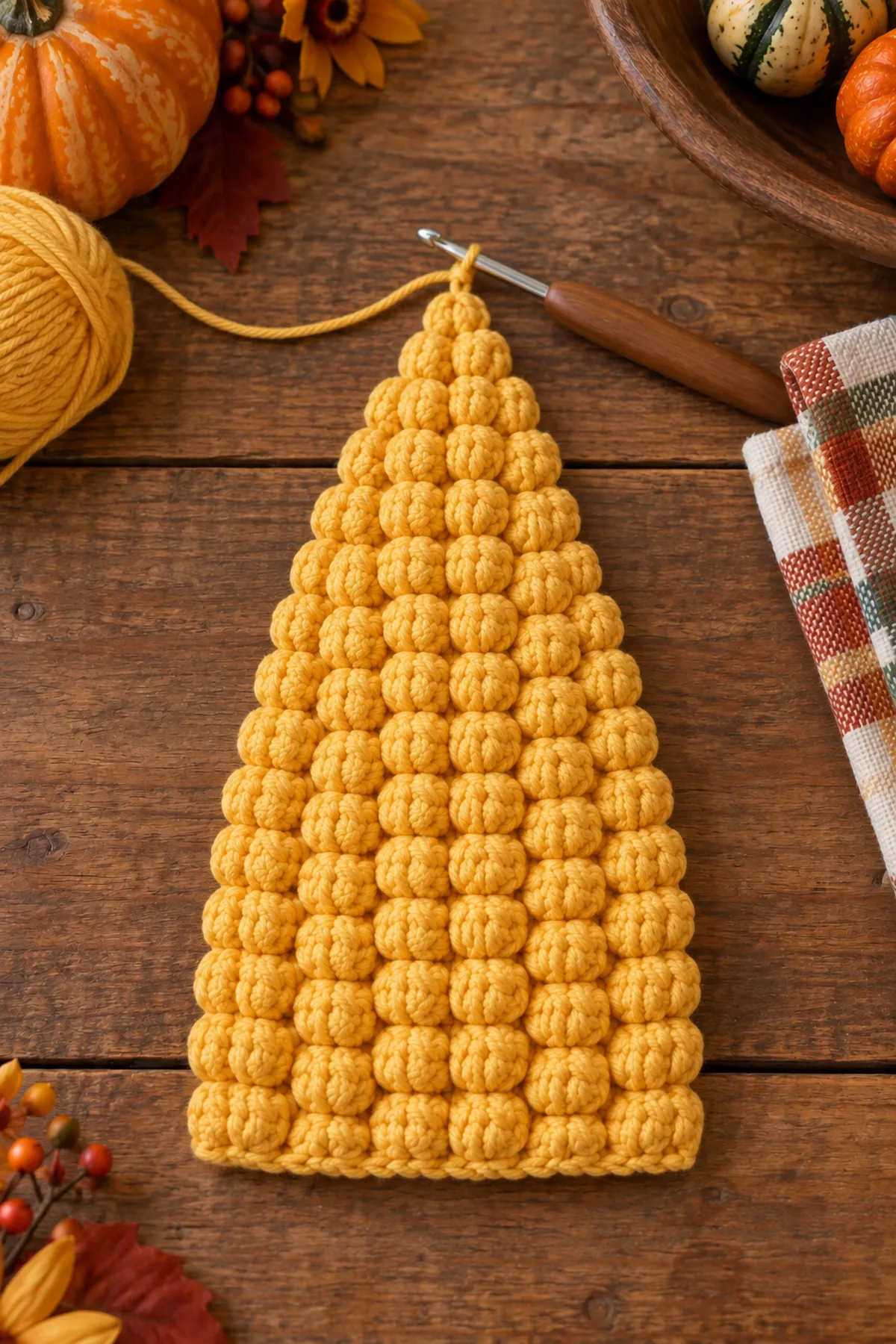
Taper the Cob Tip
Count carefully and compare the work with the finished measurements.
- Row 15: Sc2tog at both edges and work the kernel repeat between. (15 sts)
- Row 16: Sc across. (15 sts)
- Row 17: Sc2tog at both edges. (13 sts)
- Rows 18–19: Repeat the edge decreases, ending with 9 stitches; fasten off.
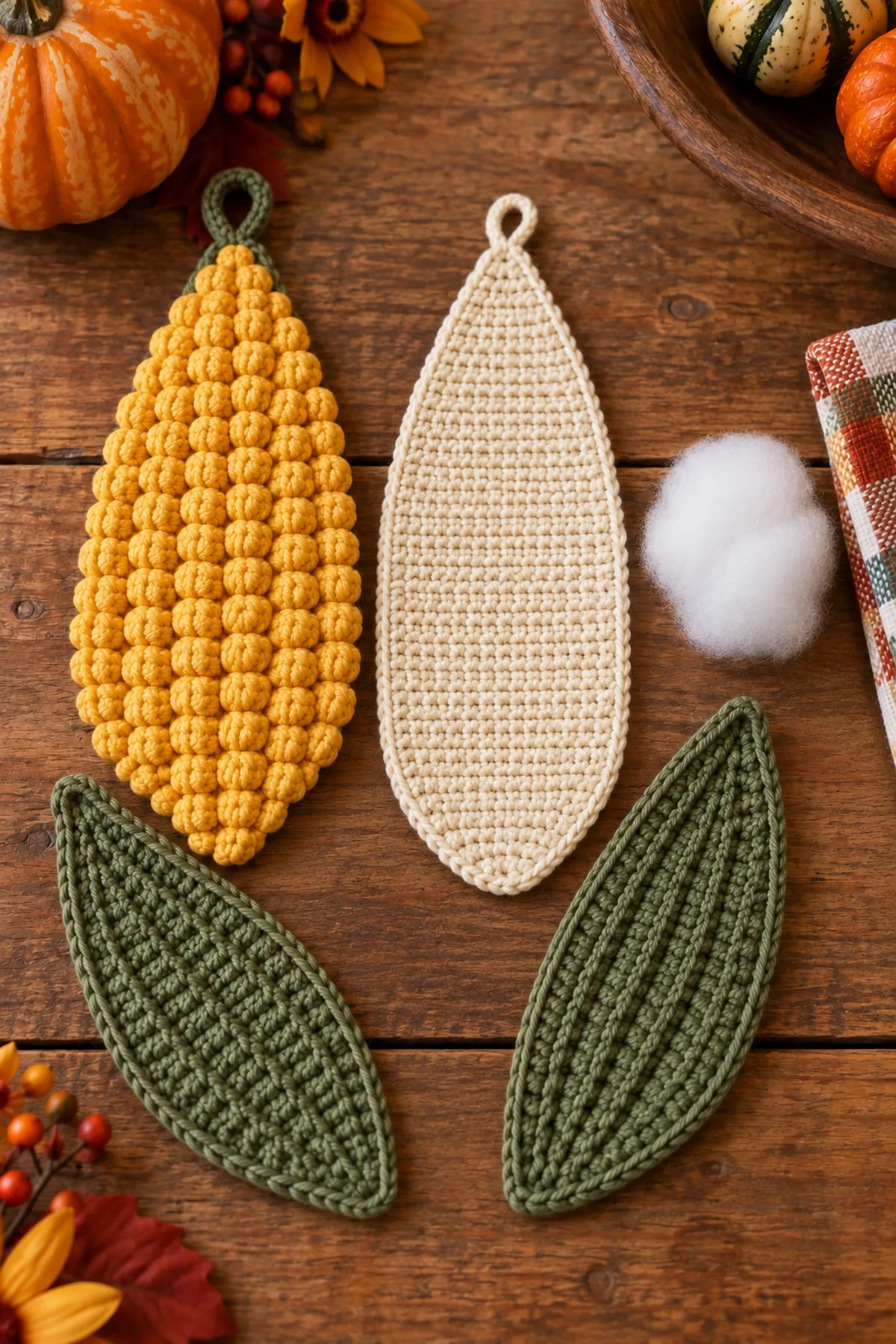
Make the Back and Husk Leaves
Count carefully and compare the work with the finished measurements.
- With cream, repeat the same 19-row shaping in plain single crochet for the backing.
- For each olive husk, ch 20 and work sc, hdc, 14 dc, hdc, sc along one side; place 3 sc at the tip and mirror the sequence along the opposite side.
- Make two husks, surface-slip-stitch one raised vein on each, and block them into long leaf shapes.
Assemble the Double-Layer Trivet
Count carefully and compare the work with the finished measurements.
- Place the gold and cream panels wrong sides together, adding optional cotton batting between them.
- Join with olive single crochet around both layers, placing extra stitches only around the tapered corners.
- Overlap the two husks across the lower third and sew along their center veins.
- At the narrow tip, ch 12 and slip stitch back to form a hanging loop; block to 8 by 5 inches.
Assembly and Shaping
Follow the project-specific assembly sequence for double layer corn cob trivet. Pin or mark every component before joining and keep the finished layout balanced.
Lay every component on a flat surface before joining. Match the marked centers first, then divide each remaining edge into equal sections. Work through both layers with consistent tension and pause after each section to check that the fabric lies flat. This measured approach prevents twisting and keeps decorative details facing the intended direction.
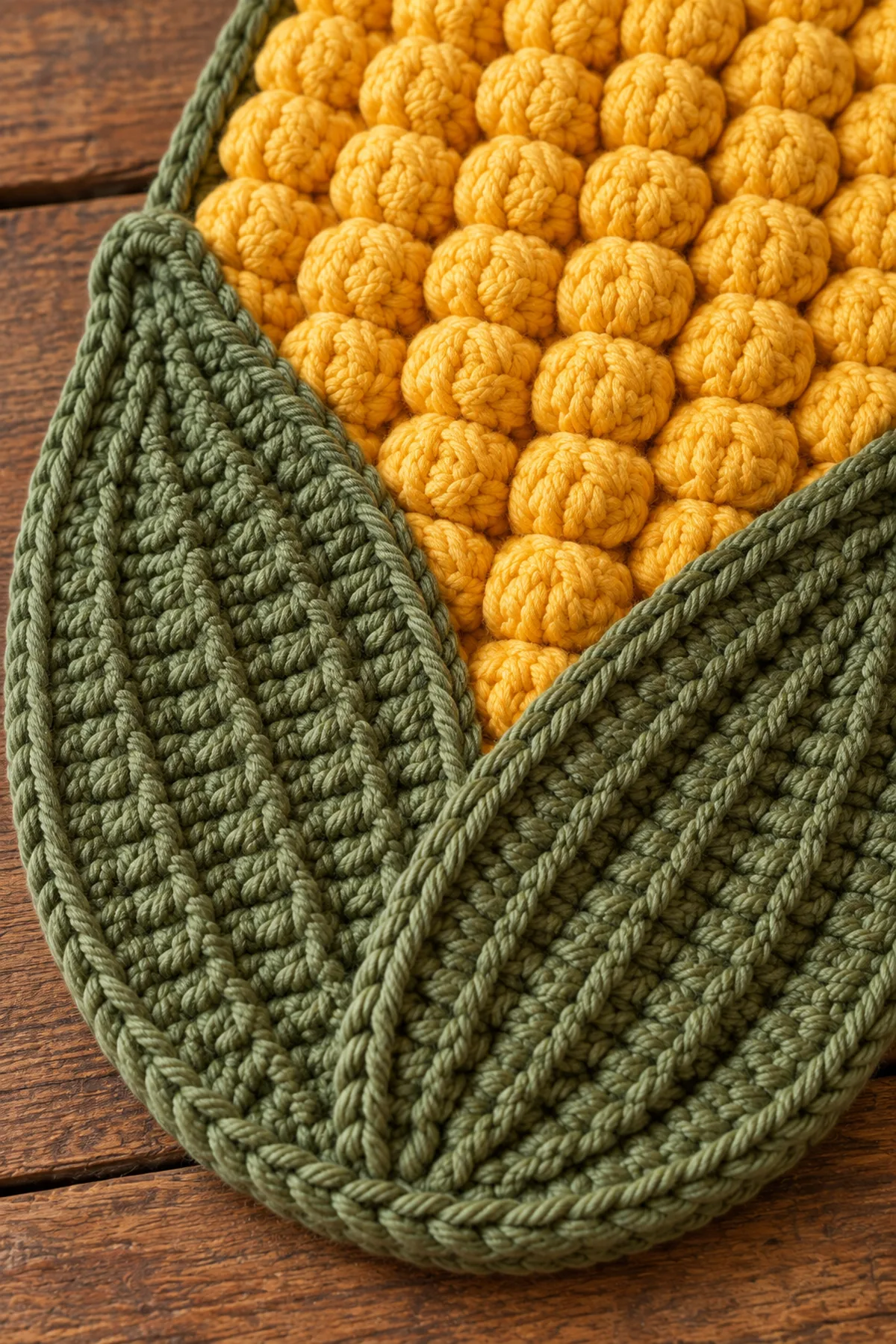
Finishing
- Weave every tail through matching stitches and reverse direction once.
- Inspect all joins, motif anchors, and border corners.
- Block to 8 inches long by 5 inches wide.
- Allow the runner to dry completely before styling.
For a polished result, weave each tail through several same-color stitches, reverse direction once, and trim only after the fabric has been gently stretched. Block to the listed dimensions without flattening textured stitches. Inspect joins, borders, straps, and decorative pieces before the project is used or gifted.
Helpful Tips
- Use locking markers at every construction checkpoint.
- Record row and motif counts as you work.
- Keep joins and color changes relaxed enough to lie flat.
- Photograph the complete layout before final assembly.
Good lighting and a contrasting stitch marker make counting much easier. If a section looks uneven, compare the current count with the previous checkpoint before continuing. Fixing one missed stitch early is faster than compensating later, and it preserves the measurements used by the assembly instructions.
Frequently Asked Questions
Is this safe for very hot cookware?
Use 100 percent cotton yarn and cotton batting only, and test with warm cookware first; never use acrylic near high heat.
Can I omit the bobbles?
Yes. Alternating front-loop and back-loop single crochet creates a flatter kernel texture.
Why are the panels different sizes?
Use the same hook and shaping counts for both, then block them together before joining.
Conclusion
The finished crochet harvest corn trivet pattern showcases bobble stitch kernels, shaped rows, double-layer assembly, leaf husk edging in a construction that matches the project from foundation through finishing.
Printable Crochet Pattern Card
Project: Crochet Harvest Corn Trivet Pattern
Skill level: Easy Intermediate Hook: 4 mm Yarn: Worsted
Finished size: Approximately 8 inches long by 5 inches wide
Card Materials
- Approximately 120 yards golden-yellow worsted-weight cotton yarn
- Approximately 95 yards cream worsted-weight cotton yarn
- Approximately 55 yards olive worsted-weight cotton yarn
- One locking stitch marker
- Optional 8-inch square of heat-resistant cotton batting
- 4 mm crochet hook
- Yarn needle
- Scissors
- Tape measure
- Blocking mats and rustproof pins
Card Instructions
- Start the Golden Corn Front: Foundation Row: With gold, ch 14. Sc in the second chain and across. Turn. (13 sts) Row 1: Ch 1, sc across. Turn. (13 sts) Rows 2 and 3: Work 2 sc in the first and last stitch with the kernel-bobble repeat between them. End Row 3 with 17 stitches. Rows 4–14: Alternate a bobble-kernel row with a flat single-crochet row, maintaining 17 stitche
- Taper the Cob Tip: Row 15: Sc2tog at both edges and work the kernel repeat between. (15 sts) Row 16: Sc across. (15 sts) Row 17: Sc2tog at both edges. (13 sts) Rows 18–19: Repeat the edge decreases, ending with 9 stitches; fasten off.
- Make the Back and Husk Leaves: With cream, repeat the same 19-row shaping in plain single crochet for the backing. For each olive husk, ch 20 and work sc, hdc, 14 dc, hdc, sc along one side; place 3 sc at the tip and mirror the sequence along the opposite side. Make two husks, surface-slip-stitch one raised vein on each, and block them into long leaf shapes.
- Assemble the Double-Layer Trivet: Place the gold and cream panels wrong sides together, adding optional cotton batting between them. Join with olive single crochet around both layers, placing extra stitches only around the tapered corners. Overlap the two husks across the lower third and sew along their center veins. At the narrow tip, ch 12 and slip stitch back to form a hanging loop; block
Finish: Check every count, weave in all ends, block to measurement, and inspect each join.