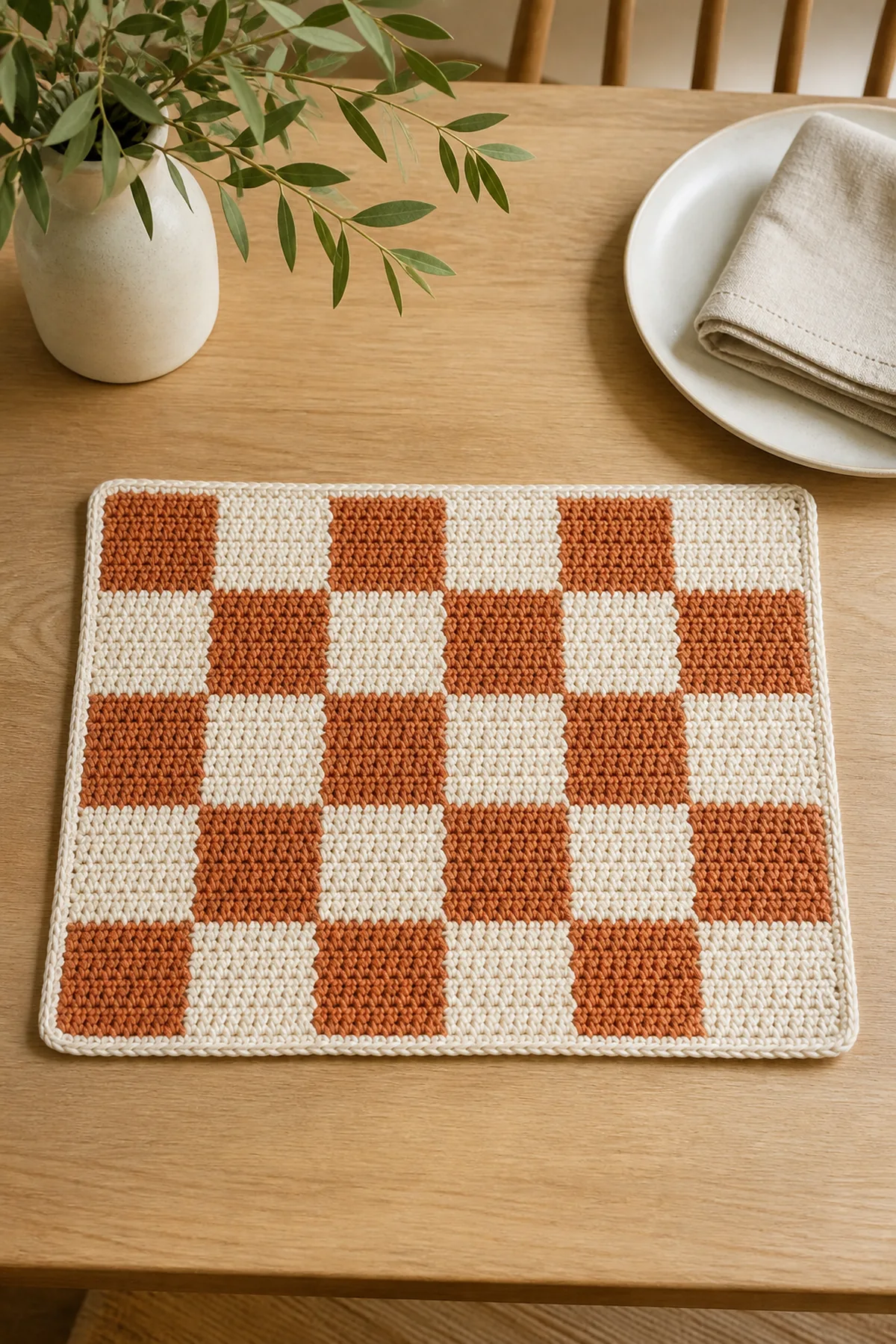
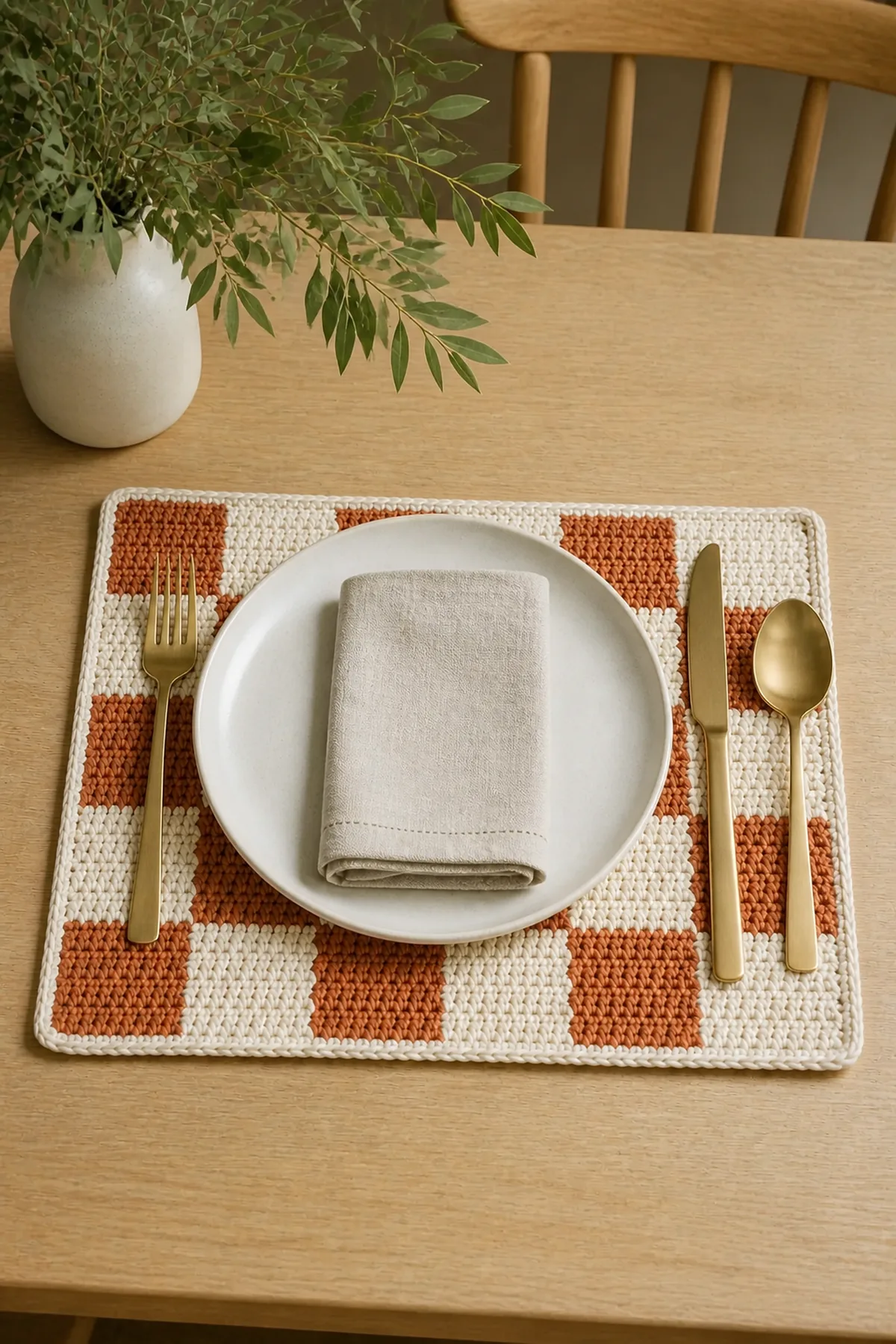
This beginner crochet checkerboard placemat brings a bold graphic pattern to the table using only single crochet and carefully timed color changes. Five blocks stretch across each row, and five eight-row bands build a balanced twenty-five-square layout. A slim cream border frames the terracotta-and-natural checks and gives the finished rectangle a polished edge.
Worked in worsted cotton with a 4.5 mm hook, the blocked placemat measures approximately 13 by 17 inches (33 by 43 cm). Tapestry crochet carries the inactive color inside the working stitches, so there are no separate squares to join and far fewer tails to weave. Every row contains sixty stitches, making the project easy to verify as it grows.
Why You’ll Love This Checkerboard Placemat
The repeating grid feels modern while relying on beginner-friendly construction. Each block is twelve stitches wide and eight rows tall. Four marker positions divide the row before you begin, and color changes always occur after stitches 12, 24, 36, and 48. At the end of eight rows, reversing the starting color automatically creates the next checkerboard band.
Cotton produces a firm, washable fabric suitable for everyday dining. The pattern also adapts well to a set: repeat the same two colors for a coordinated table or rotate several accent shades against one consistent cream. Preserve the exact block dimensions across the set so every placemat finishes at the same size.
Pattern Details
- Skill level: Beginner
- Terminology: US crochet terms
- Finished size: About 13 by 17 in
- Hook: 4.5 mm (7)
- Gauge: 14 sc and 12 rows equal 4 in
- Estimated time: 4–5 hours
- Construction: Flat tapestry-crochet rows with two border rounds
Materials
- 220 yd (201 m) natural-cream worsted cotton
- 190 yd (174 m) warm-terracotta worsted cotton
- 4.5 mm crochet hook
- Six locking markers
- Yarn needle, scissors, tape measure, blocking mat, and rustproof pins
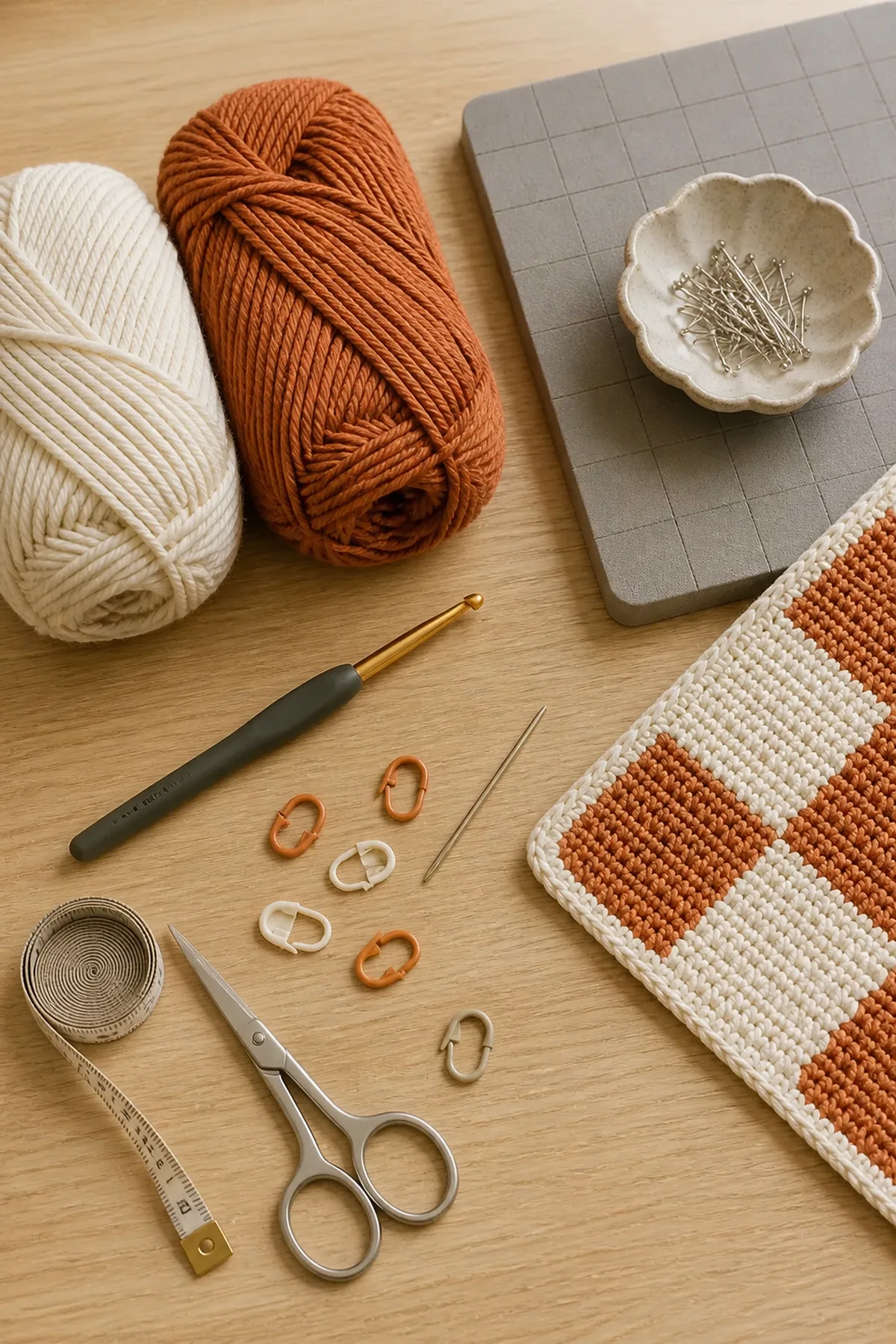
Select two smooth cotton yarns with similar thickness and twist. Strong contrast makes the grid easiest to see, but softer combinations such as sage and cream or dusty blue and oatmeal also work. Wash a small swatch if you need to confirm colorfastness before placing the mat beneath pale dishes.
Abbreviations and Color Changes
- ch: chain
- sc: single crochet
- st(s): stitch(es)
Tapestry color change: Work the final single crochet of the old block until two loops remain on the hook. Yarn over with the new color and pull it through both loops. Place the unused strand along the top edge of the previous row, then crochet over it until the next change. Straighten the enclosed strand gently before beginning the next twelve-stitch block.
Before You Begin
The turning chain one does not count as a stitch. Turn after every row and work the first single crochet in the first stitch. Place markers after stitches 12, 24, 36, and 48. Move the markers upward every few rows so the color boundaries remain easy to inspect.
Complete Crochet Instructions
Row 1: Establish Five Blocks
With cream, ch 61. Sc in the second chain from the hook and in the next 11 chains. On the final yarn-over of stitch 12, change to terracotta. Work 12 terracotta, 12 cream, 12 terracotta, and the final 12 stitches in cream. Ch 1 and turn. (60 sts)
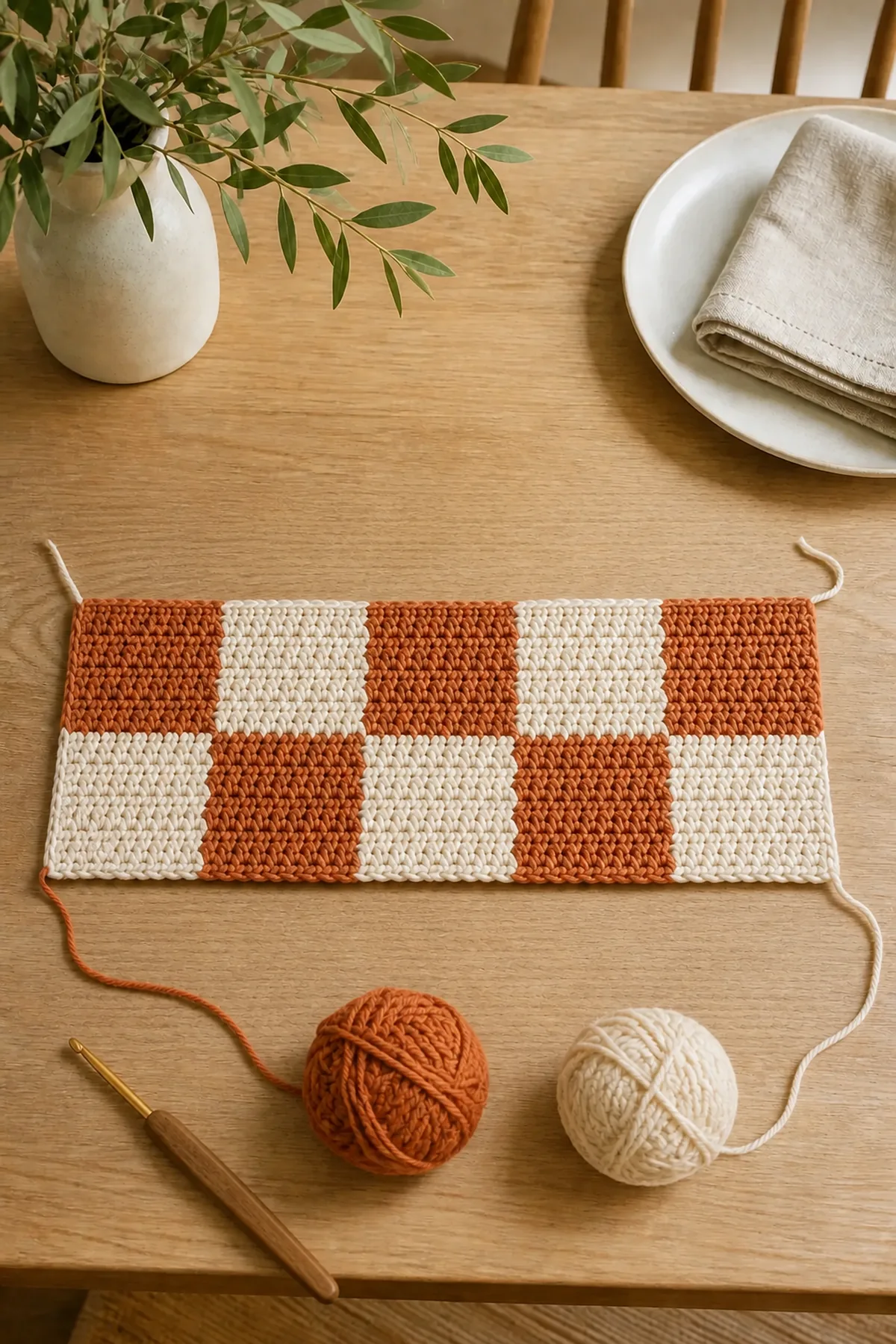
The first row reads cream, terracotta, cream, terracotta, cream from either direction because the five-block order is symmetrical. Check that each section has twelve stitches before beginning Row 2.
Rows 2–8: Complete the First Band
Continue the same five-block color order for seven more rows. Change colors after stitches 12, 24, 36, and 48. Ch 1 and turn at every row end. (60 sts)
After Row 8, each colored rectangle should be twelve stitches wide and eight rows tall. Count the horizontal ridges rather than estimating height. Keep both working yarns attached for the next reversed band.
Rows 9–16: Reverse the Colors
Begin Row 9 with terracotta. Work five twelve-stitch blocks in terracotta, cream, terracotta, cream, and terracotta. Maintain this order through Row 16. (60 sts)
At the boundary, the new terracotta blocks sit above cream and the new cream blocks sit above terracotta. If matching colors stack vertically, reopen the first row of the band and reverse its starting color.
Rows 17–40: Finish the Grid
Rows 17–24: Repeat the first band, beginning with cream. (60 sts)
Rows 25–32: Repeat the second band, beginning with terracotta. (60 sts)
Rows 33–40: Repeat the first band, beginning with cream. (60 sts)
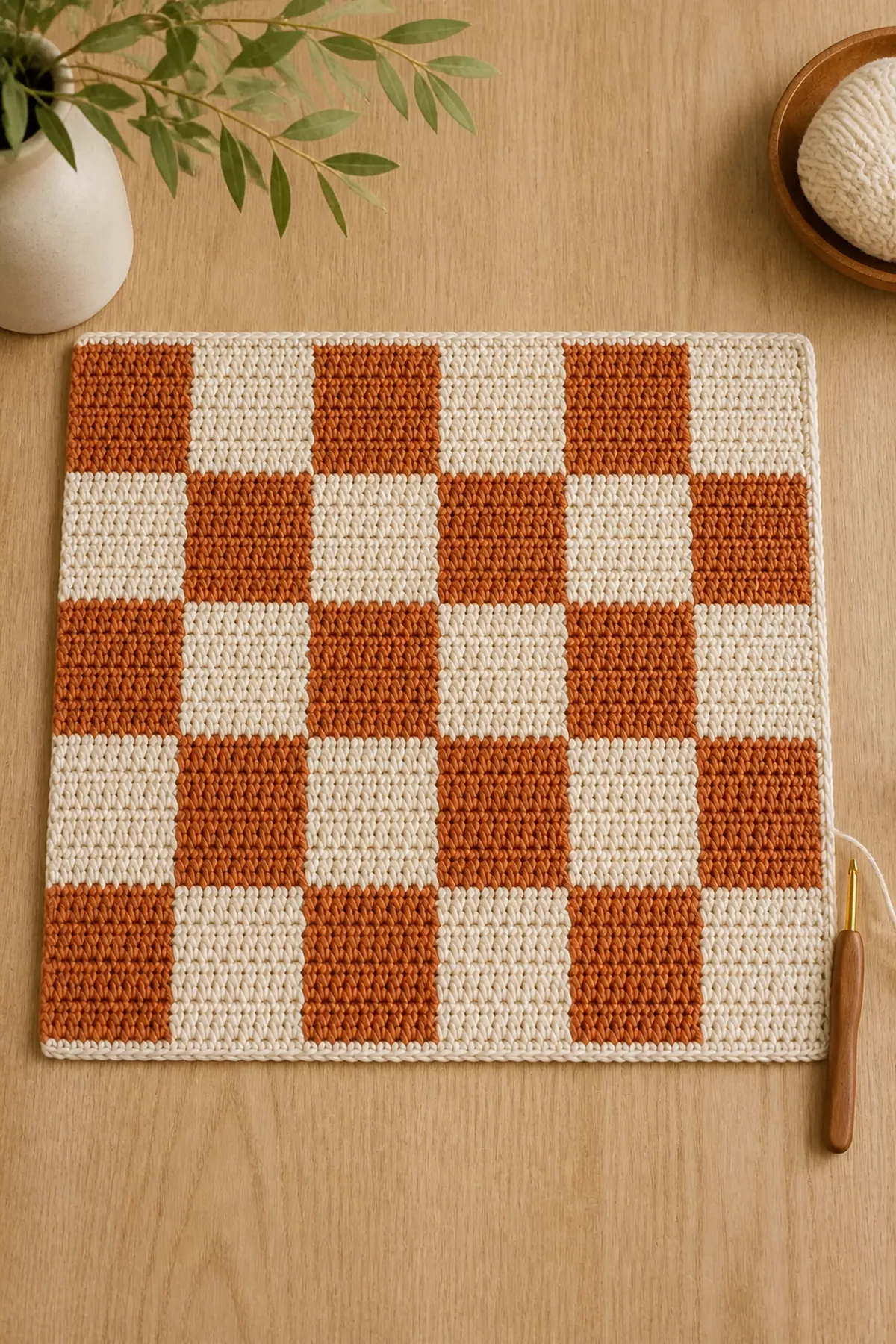
Fasten off terracotta after Row 40 and keep cream attached. The finished field contains five blocks across and five bands tall. Count twenty-five large checks and inspect every boundary for an accidental thirteen- or eleven-stitch block.
Add the Cream Border
With the right side facing, ch 1 and sc across all sixty top stitches. Place 3 sc in the corner. Work 1 sc into the end of each of the forty side rows and place 3 sc in the next corner. Work 60 sc across the unused foundation loops, place 3 sc in the corner, work 1 sc in each of forty opposite row ends, and place 3 sc in the final corner. Join to the first sc.
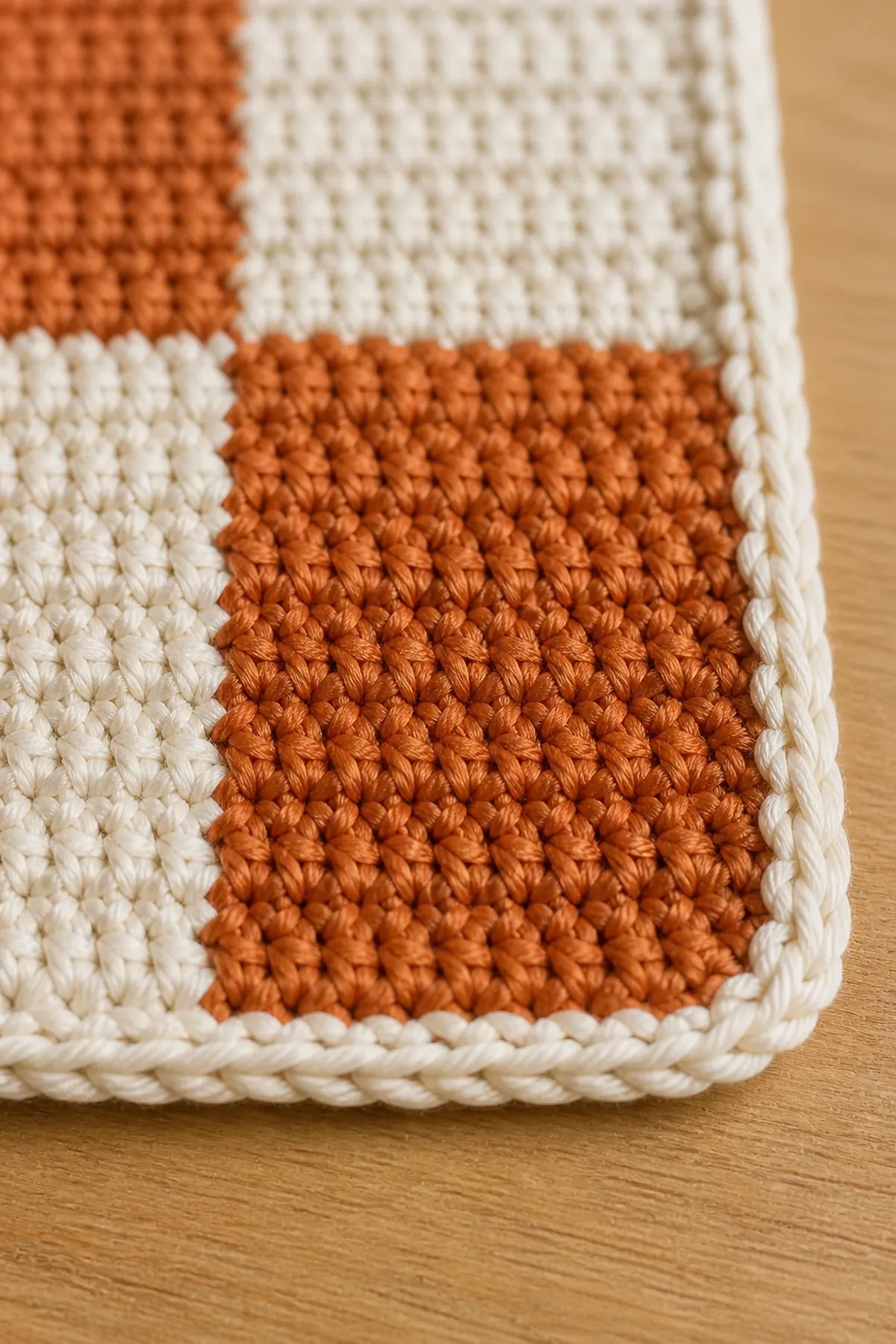
For the second border round, work 1 sc in every ordinary stitch and 3 sc in the center stitch of each corner group. Join, fasten off, and leave a 6-inch tail. If an edge ripples, reopen that section and reduce the number of side stitches rather than forcing the mat flat.
Finishing and Blocking
- Weave each tail through the back of same-color stitches for at least one inch.
- Reverse direction through a neighboring row and trim.
- Wet the placemat with cool water and press it in a towel without twisting.
- Pin it to 13 by 17 inches, using the grid to straighten every color boundary.
- Allow the cotton to dry completely before removing the pins.
Helpful Tips
- Mark each block: Boundaries follow stitches 12, 24, 36, and 48.
- Change early: Pick up the new color on the final yarn-over of the preceding stitch.
- Relax carried yarn: A tight inner strand causes puckering.
- Count both directions: Every row has sixty stitches and every band has eight rows.
- Block to a grid: Straight vertical and horizontal boundaries make the design look crisp.
Frequently Asked Questions
Can I make smaller squares?
Yes. Choose a new block width and height and apply them consistently to all twenty-five blocks. An odd number of blocks across preserves the symmetrical starting order.
Why are my color changes slanted?
Pick up the new color on the final yarn-over before the boundary and keep each section at exactly twelve stitches. Straight blocking corrects minor visual waviness.
Do I have to carry the yarn?
No. Small bobbins eliminate carried strands but create more ends. Carrying is efficient across these short twelve-stitch blocks and keeps both colors available.
Can I machine-wash the placemat?
Follow the yarn label. A mesh laundry bag and gentle cycle protect the border. Reshape the mat while damp and dry it flat.
Printable Checkerboard Placemat Card
Size: 13 by 17 in. Hook: 4.5 mm. Row count: 60 stitches.
- Ch 61 and work five twelve-stitch blocks: cream, terracotta, cream, terracotta, cream.
- Repeat that order through Row 8.
- Rows 9–16: reverse the order.
- Rows 17–24: first order; Rows 25–32: reversed order; Rows 33–40: first order.
- With cream, single crochet around, using 60 stitches on long edges, 40 on short edges, and 3 in corners.
- Add a second border round, weave ends, and block.
Conclusion
Exact twelve-stitch blocks and eight-row bands make this beginner crochet checkerboard placemat predictable from the first foundation chain to the final border. Once the two-color rhythm feels comfortable, repeat the pattern for a practical, visually striking table set.